Austria’s Montafon Valley Is Skiing’s Best Kept Secret
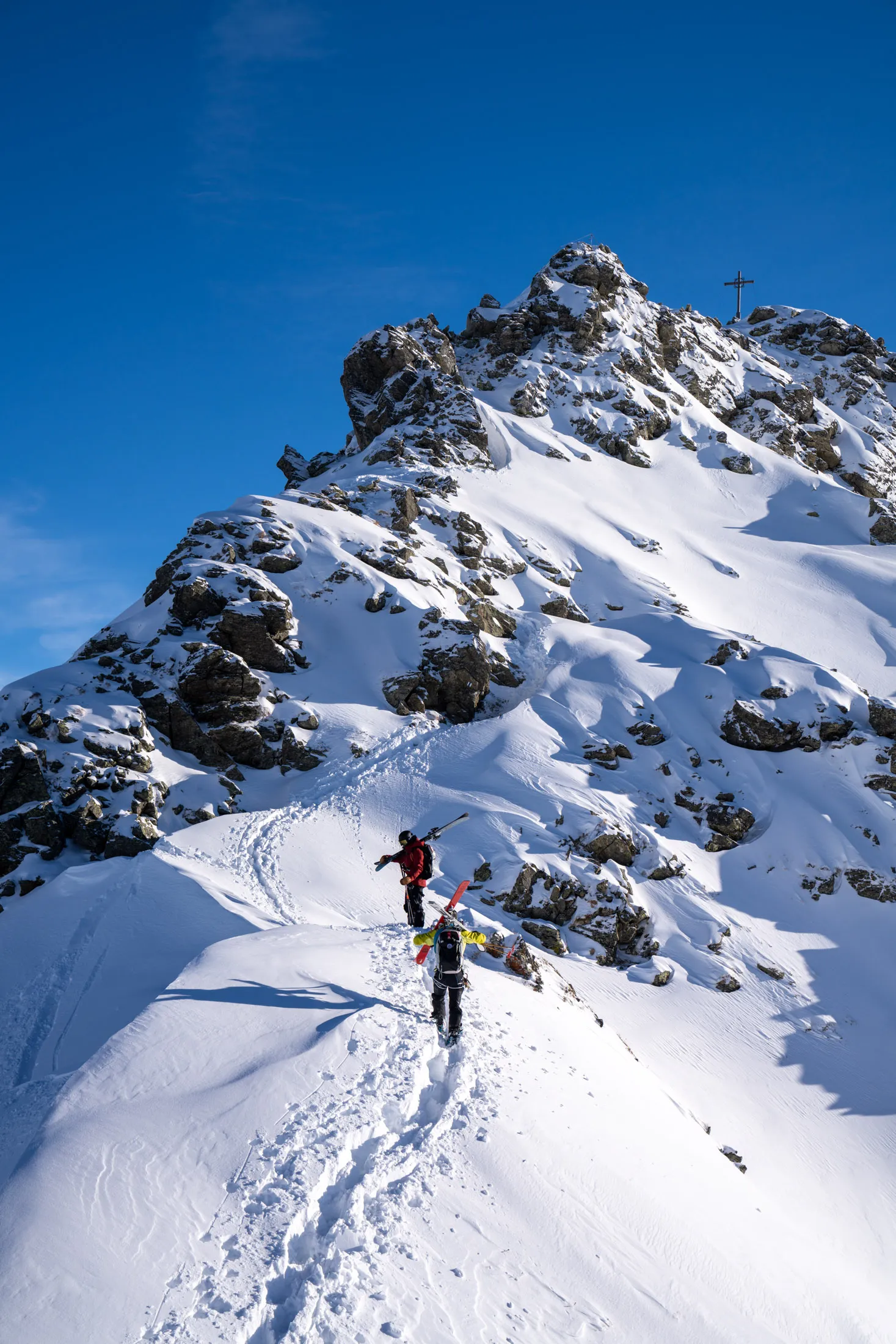
The author and the group’s guide, Hannes Schneider, climbing to Muttjöchle, one of the peaks at Kristberg. Schneider is carrying the photographer’s skis so she can capture this photo.
Photographer: Cassie Floto-Warner for Bloomberg Businessweek
I’d been in Austria’s Montafon Valley only a few hours when my partner, Tess, and I found ourselves sitting inside a wood-paneled tavern in the village of Schruns. Across from me was Hannes Schneider, who was to be our ski guide for the next few days. Schneider, a fit and cheerful man with patchy black stubble, slid a tablet across the table, its glowing screen filled with the topographic lines of peaks and valleys. With one finger he traced a route over the tablet, mapping the ski tour we’d take a few days later. With the other hand he lifted a weiss bier to his lips and took a sip. I asked Schneider, who grew up in the valley and has guided here for four years, if he’d ever led an American through these mountains before. “No, never,” he responded. “We don’t see many Americans here.”
It was just what I wanted to hear. I’d been drawn to Montafon precisely because the valley in Austria’s Vorarlberg region is unknown to most Americans—most tourists, in fact. It wasn’t until a few years ago, after a friend had stumbled upon the place, that I first heard of it, and I write about skiing for a living. My friend told me that Gargellen, one of the five ski areas in the valley, “is like Alta on steroids.” Invoking the name of the Utah resort, one of the great skiers’ mountains, known for its copious powder and challenging terrain, is catnip for someone like me. Then he sealed the deal: “Nobody goes there. The slopes are practically empty.”