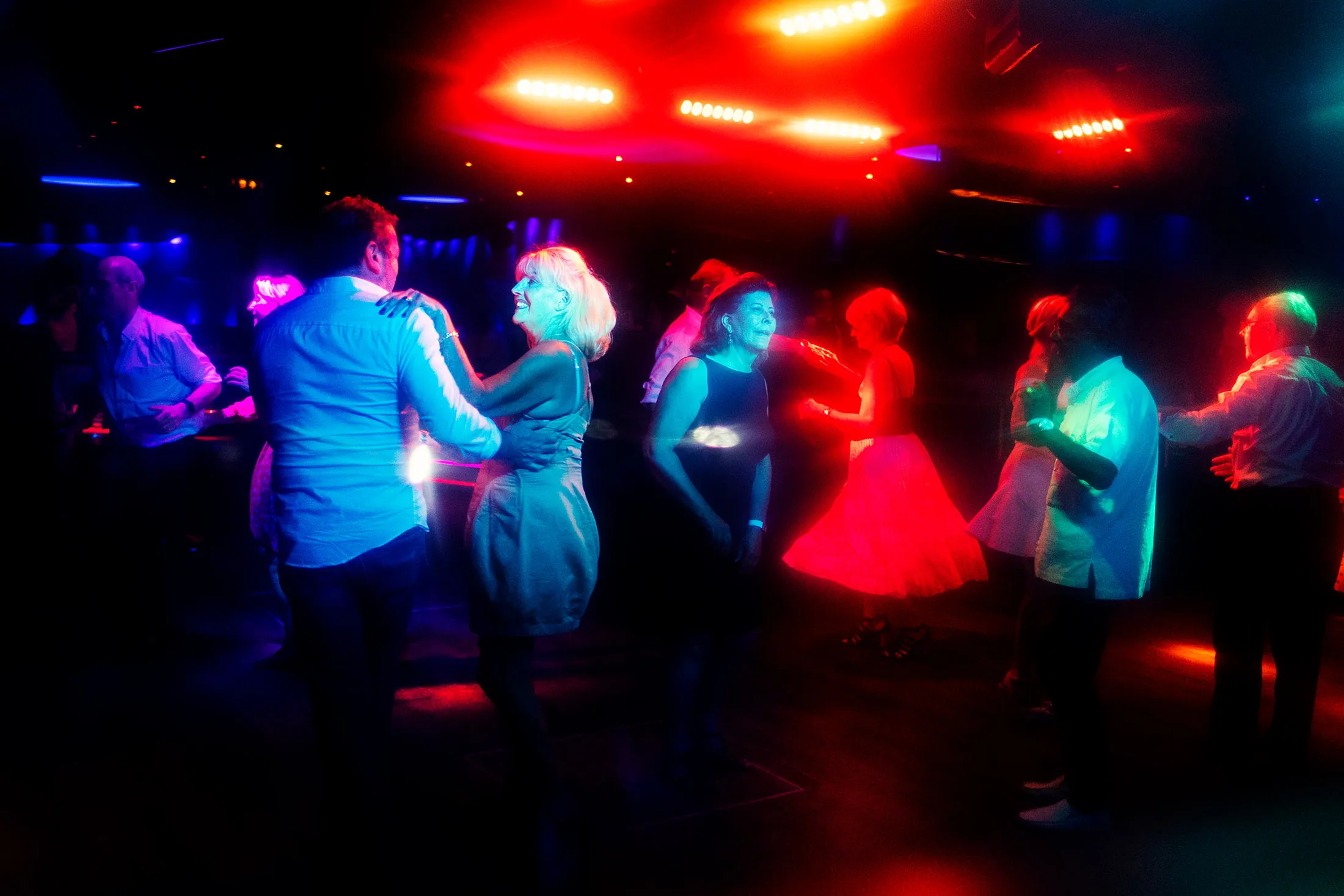
Dancers at the famous nightclub Duplex in Paris.
Photographer: Julie GlassbergWe Are So Not Ready for a Society Where Living to 100 Is Common
A few takeaways from working at the Stanford Center on Longevity.
The photos accompanying this story are from a project called Stayin’ Alive. Julie Glassberg got the idea for it about 15 years ago, when she was at a famous brasserie in Paris, La Coupole, which organizes afternoon thés dansants (dancing teas). “A very chic old lady, quite elegant, came to talk to us. She told us she’d come to the thé dansant every Sunday. She loved to dance, and she’d also meet lovers!” Glassberg wrote in a short essay explaining her project. (“Some bring their lovers. Some are single and meet lovers. Some are married and meet lovers. You’ve got everything,” she clarifies.) The project, produced as part of a national commission with the support of the Bibliothèque nationale de France, includes seniors who attend thés dansants throughout the country. Glassberg says her goal is to expand her portfolio to include older people with diverse interests in France and other countries.
At the end of 2020, the Stanford Center on Longevity commissioned me to compile its research into a report for a general audience. The center’s mission is to accelerate scientific discoveries that improve the likelihood and quality of longer lives and to change cultural norms around the economic and social contributions of older adults, hence the interest in sharing its work with the public and policymakers. Specifically, researchers there were studying what life would look like when people routinely lived to 100. At the time, I was a freelance writer with no expertise on the topic beyond having a grandmother who reached 102—vibrant, opinionated and engaged with the world. But the assignment was a welcome diversion from a reality in which so many lives were being cut short.