The Cosmic Radiation Forecast Could Be Bad for a Human Mars Mission
A major decline in sunspots could leave the solar system exposed.
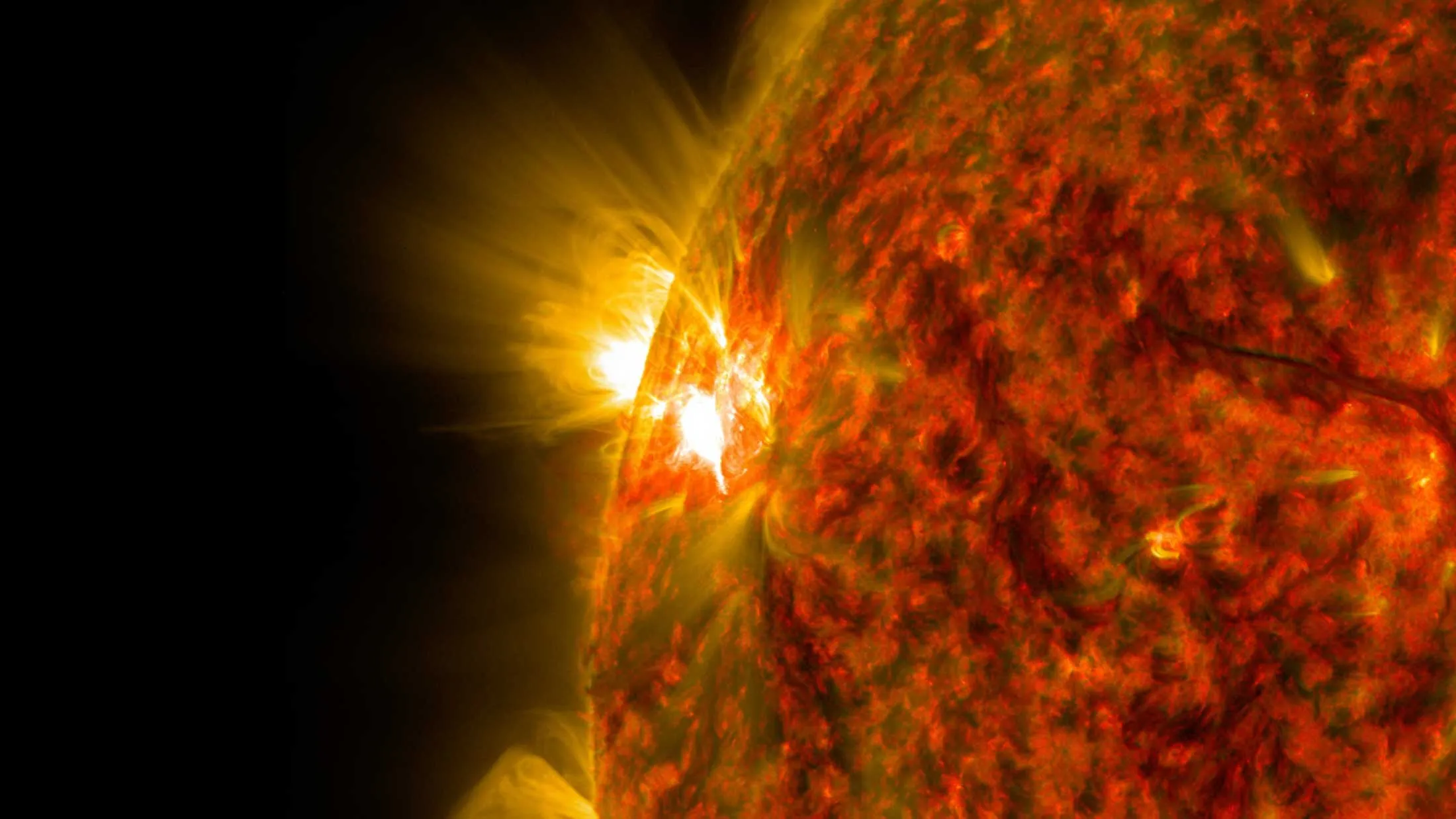
The bright flash of an M-class flare is seen exploding on the left side of the sun in this image from Nov. 5, 2014. The image was captured by NASA’s Solar Dynamics Observatory in extreme ultraviolet light that was colorized in red and gold.
Source: NASA
There’s something strange going on with the sun. The theory—admittedly a controversial one—is that we’re entering a grand minimum, in which the sun’s spot cycle fizzles out and cosmic radiation becomes more pervasive. We haven’t seen one since the Space Age began.
Sunspots are areas where “intense magnetic flux” has pushed up to the star’s surface, manifesting in storms whose numbers wax and wane over an 11-year cycle. At their most active, they boost the sun’s magnetic field, which envelops planets and protects them from the perils of galactic cosmic rays—charged particles from long-dead stars. Periodically, the sunspot cycle seems to fade entirely, and few or no spots show up for decades. If that happens, and we find ourselves in a grand minimum, says Scott McIntosh, a solar researcher at the National Center for Atmospheric Research in Boulder, Colo., the sun’s magnetic umbrella “will be made of Swiss cheese.”