Did This Jeweler to the Stars Commit the Biggest Bank Fraud in India’s History?
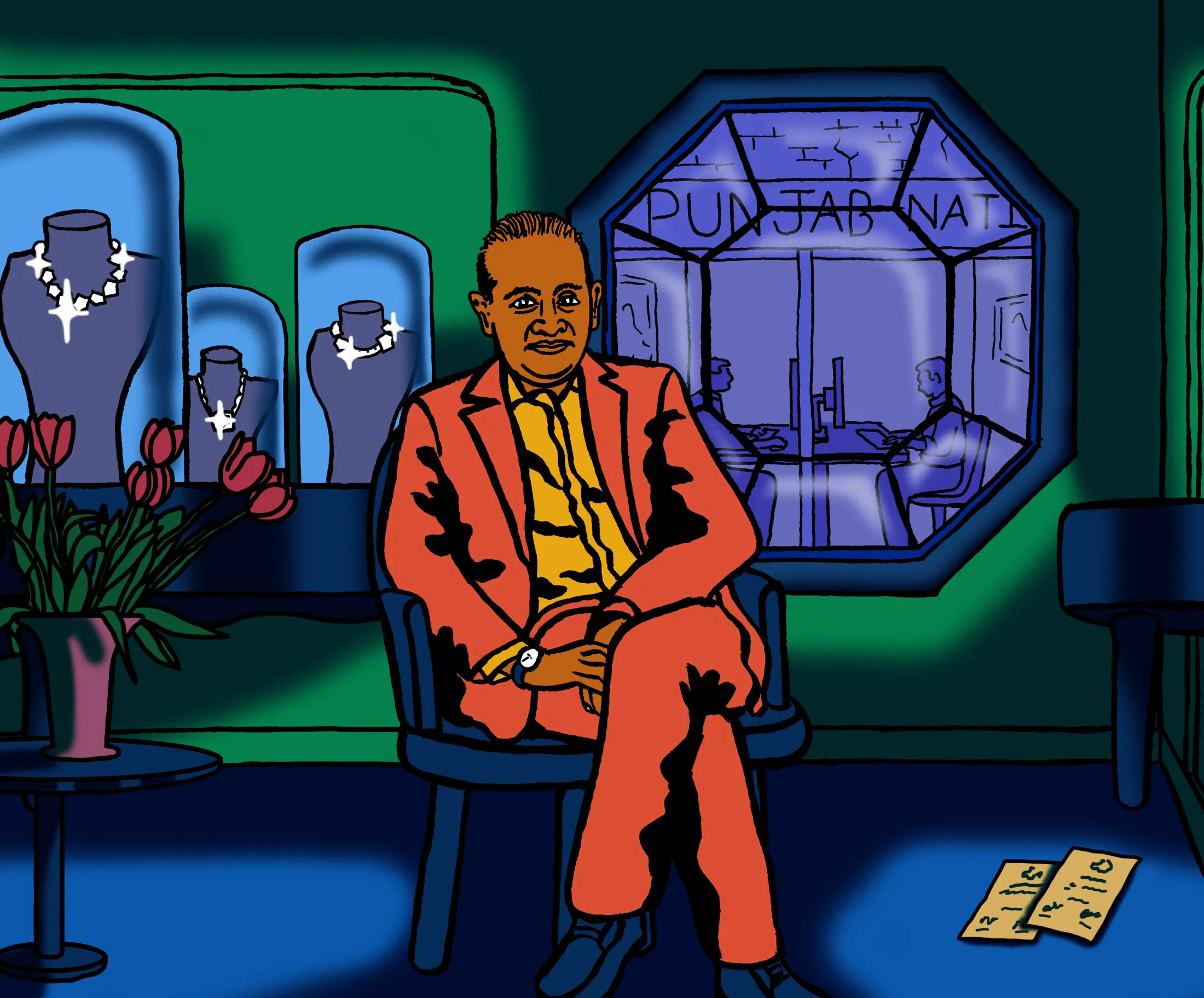
Illustration: Gaurab Thakali for Bloomberg Businessweek
Nirav Modi didn’t seem like the kind of person who needed to rob $2 billion from a bank. He’s a short man, 47 years old and losing hair, the pocket square in his jacket always arranged to fussy perfection. His daintiness befitted a jeweler to the stars. Kate Winslet wore a Modi bracelet and Modi earrings to the Oscars. Dakota Johnson wore a similar set to the Golden Globes. Priyanka Chopra gazed out of Modi advertisements. Naomi Watts attended the opening, in 2015, of his emporium on Madison Avenue. Christie’s once put his Golconda Lotus necklace on the cover of its catalog and auctioned it for more than $3 million. His stores—in Las Vegas, Macau, Singapore, Beijing, London—were boutiques of bling, where white light bounced off the arrayed gold and diamonds. He told people he wanted 100 shops by 2025. Last year, Forbes estimated his worth at $1.8 billion. A good casting director would have marked him for the role of heistee, not heister.
Even the alleged crime, when it finally broke water in February, appeared to swim against the current of Modi’s glamorous life. The money had been taken from Punjab National Bank in 1,213 grinding doses over seven years. It was the biggest bank fraud in India’s history, and it came robed in technical jargon: letters of undertaking and Swift bypasses, margin money and “nostro” accounts, core banking solutions and buyer’s credit facilities.