



The Most Potent Weapon in Russia’s Disinformation War
Storm-1516 uses fabricated videos, phony websites and anonymous influencers to spread tales about election fraud, corruption and sexual abuse.
A two-minute video, shared March 6 on the social media platform X, appeared to offer evidence linking Ukrainian President Volodymyr Zelenskiy to the late convicted sex offender Jeffrey Epstein. One post alone racked up 2.9 million views.
The clip, a pastiche of stock images and real news footage, featured emails purportedly sent to Epstein by the owner of a casting agency that the video claimed Zelenskiy used when he was a popular comedian. “We got a new one,” said one of them. “Very promising 13 y.o., acting background, 173 cm. Good body, long hair.”
But the email is fake. It was dated Tuesday, Jan. 3, 2010, a Sunday. And there are no emails from the person who allegedly wrote them, Yehor Skalyha, or the agency, Centrocast, in the Epstein files released by the US Justice Department. At the time, Skalyha didn’t own Centrocast. He and others bought the company in 2022 and renamed it Fire Point, which now makes missiles and drones. A spokesman for Skalyha said he had no contact with Epstein.
The video was posted by an account on X called Johnny Midnight, aka @its_The_Dr, which has 633,000 followers. It is one of more than 190 fabricated stories since August 2023 that Bloomberg News has identified as being part of a Russian influence operation known to Western intelligence agencies and researchers as Storm-1516. Together they have hundreds of millions of views on social media.
The Johnny Midnight account was one of the most prolific sharers of these stories, posting almost 60 of them. The account is based in the US, according to its X profile. It was registered in 2020 and, since February 2024, has carried a blue check, indicating a paid status that boosts a user’s posts in X’s algorithm. But the real identity of its owner is unknown. A few days after Bloomberg asked X for comment in March, the platform suspended the account. It was reinstated a week later. X didn’t respond to questions.
After this story was published, the Johnny Midnight account sent a direct message on X to Bloomberg suggesting that falling for false narratives doesn’t necessarily make a social media poster part of a disinformation campaign. “Sometimes our sources may get it wrong is my point,” the message said.
The disinformation campaign has flooded social media with stories alleging wrongdoing by politicians aligned with Europe and the US. It sits at the heart of Russia’s hybrid-warfare strategy, alongside sabotage, assassinations and covert attacks on infrastructure — all designed for plausible deniability.
But the fingerprints of Storm-1516 are easy to identify with a trained eye. Its videos showcase forged documents, staged testimonies and AI-enhanced audio or visual manipulations. Though the targets vary, the themes are consistent: allegations of election fraud, sexual abuse by officials, Zelenskiy living a life of luxury. Storm-1516 seeds its stories through websites purporting to be news media and a network of influencers, some of whom retweet posts by bots. Social media algorithms widen the audience. The goal isn’t so much changing beliefs as planting doubt and exploiting wedge issues.
A Flood of False Narratives
Note: Data from Aug. 1, 2023, through March 31, 2026
Bloomberg identified Storm-1516 narratives with the help of Clemson University’s Media Forensics Hub and the Microsoft Threat Analysis Center’s public description of signature characteristics. More than 40% were aimed at undermining support for Ukraine, and one-third targeted elections in other countries.
While it isn’t possible to say with certainty whether a particular video is part of the Storm-1516 operation, Bloomberg based its determinations on a number of characteristics: how the stories spread on social media through a distinct set of influencers or websites; the use of the same actors or AI-manipulated faces; the deployment of pro-Kremlin narratives; and claims that are unverifiable. Many are presented by people pretending to be whistleblowers or investigative journalists exposing wrongdoing. The videos all have a similar look and sound, often presenting stories in the format of news reports.
Darren Linvill, a professor at Clemson in South Carolina and co-director of its Media Forensics Hub, was the first to identify the Russian campaign in late 2023. But he didn’t give it a name. In April 2024, Microsoft, which tracks cyber threats, designated the operation Storm-1516, warning that US audiences were reposting disinformation about Ukraine, likely unaware it came from Russia. (“Storm” is the company’s term for threat actors. Since then, Microsoft, which declined to comment for this story, has labeled the group a Russian nation-state actor and renamed it Neva Flood.)
“There’s no question in my mind that Storm-1516 is the most successful part of the covert Russian disinformation apparatus,” Linvill says.
Moscow has a long history of weaponizing disinformation. In the 1980s, the KGB planted the conspiracy theory that HIV was cooked up in a US lab. More recently, Russia attempted to sway both the Brexit referendum and the US presidential election in 2016.
Since then, the opportunity to spread fabricated content has increased. Social media platforms are taking down guardrails to monitor content. High-profile figures, including Donald Trump and Elon Musk, share manipulated images or repost unverified claims. And the US government has dismantled agencies aimed at exposing the activities of covert nation-state actors. With a boost from AI, which has sped up production and lowered costs, Storm-1516 has become an assembly line in a Golden Age of disinformation.
While its stories are shared on multiple platforms, including TikTok, Telegram and Meta’s Facebook and Instagram, X has proven especially fertile ground. Since Musk bought the platform in 2022, it has discontinued many of its trust and safety measures, including policies aimed at combating misinformation. Now, it largely relies on user-generated “community notes.”
But most notes are never published. X displays only those rated as helpful by contributors with “different points of view.” Fewer than 20% of the false narratives identified by Bloomberg carry a community note. And even if one post has a note, others featuring the same video may not. They remain on the platform, despite X’s own terms of service barring users from sharing what it calls “inauthentic content,” including “manipulated, or out-of-context media that may result in widespread confusion on public issues.”
WATCH The Golden Age of Disinformation
With more than 600 million monthly active users, X is a key communication tool for officials around the world and an important source of information for voters. Its decision to cut content moderators has effectively allowed these narratives to ripple through the global public square, with politicians often repeating stories made up in Moscow.
Wifredo Fernandez, X’s director of global affairs, told members of the UK Parliament in March that Russia was trying to “flood the zone with a particular type of narrative” and that the platform suspended 800 million accounts in 2024. He didn’t specify how many were tied to Russia. The company didn’t respond to a detailed list of questions sent by Bloomberg.
The European Commission opened an investigation in 2023 to look at possible violations of the European Union’s Digital Services Act, which requires online platforms to adhere to transparency rules and combat misinformation. In December, Brussels fined the company 120 million euros ($141 million), saying it had deceived users by falsely implying that accounts with blue checks had verified their identities. It also said X failed to meet ad transparency rules and stonewalled researchers’ access to data. The company appealed the fine and submitted proposed changes. In March, X agreed to revamp its verification system in the EU, in a proposal currently being vetted by the commission. Its broader investigation into X’s handling of information manipulation is ongoing.
It was the EU’s first penalty under the Digital Services Act, and it sparked a backlash in Washington. Vice President JD Vance posted on X that the EU “should be supporting free speech, not attacking American companies over garbage.” Secretary of State Marco Rubio called it “an attack on all American tech platforms and the American people by foreign governments.”
Earlier this year, X suspended 20 accounts that were among those Bloomberg had been tracking. But many of the most frequent sharers remain active and anonymous, with the blue checks prioritized in X’s algorithmic feed.
Top X Accounts Spreading Storm-1516 Disinformation
| Account | False Narratives Spread | Total Views |
|---|---|---|
| @its_The_Dr | 58 | 74M |
| @DangerousThinkg | 54 | 24M |
| @BowesChay | 49 | 24M |
| @daniel_gugger | 40 | 37M |
| @DarrenPlymouth | 40 | 32M |
| @TheSaviour | 39 | 27M |
| @Truthtellerftm | 36 | 28M |
| @SprinterPress | 36 | 23M |
| @Trump_Fact_News | 33 | 43M |
| @ROYALMRBADNEWS | 24 | 27M |
Note: Based on narratives identified by Bloomberg as having Storm-1516 characteristics. Bloomberg couldn’t determine if accounts shared disinformation wittingly. Data only include accounts active as of April 23.
“Before Musk, X did have a trust and safety team that acted upon content that was flagged by its users and removed content that was found to be in violation of their terms,” says Filippo Menczer, professor of informatics and computer science at Indiana University Bloomington, where he directs the Observatory on Social Media. “Enforcement has been hugely weakened.”
Russia’s global information war is overseen by Sergei Kiriyenko, first deputy chief of staff of the presidential administration, according to two European intelligence officials who declined to be named because they weren’t authorized to discuss the matter publicly. Once Russia’s youngest prime minister, Kiriyenko, now 63, holds regular meetings to draw up media plans, one of the officials says. Sanctioned by the US, the EU and the UK, he is one of the most powerful Kremlin officials, overseeing domestic policy and political messaging. Kremlin spokesman Dmitry Peskov declined to comment.
Multiple disinformation campaigns promote complementary stories in line with the Kremlin’s agenda. A so-called Doppelganger operation spoofs mainstream websites, and another spreads clips about fake law enforcement announcements. The Foundation to Battle Injustice, a pseudo-human rights group founded by the late Russian mercenary leader Yevgeny Prigozhin, produces its own disinformation. The EU sanctioned it in July, citing its work to amplify Storm-1516 content. The foundation didn’t respond to requests for comment.
Western officials say Russia’s military intelligence agency, the GRU, is behind Storm-1516. Its Unit 29155, led by Oleg Kushnir, financed the group’s servers and AI tools to generate fabricated stories, according to a Ukrainian intelligence assessment seen by Bloomberg. It says GRU officer Yury Khoroshenky coordinates both Storm-1516 and a hacking group known as UAC-0056, also called Ember Bear, which US agencies said in 2024 was used to attack Ukraine and other countries.
Since the full-scale invasion of Ukraine, Russia has ramped up funding for state media and online propaganda. Its budget for this year shows the government is planning to spend about $1.8 billion.
The number of narratives Bloomberg identified as Storm-1516 more than doubled in the first quarter of 2026, compared with the same period the previous year, with almost daily output in late March and early April. A dozen focused on Hungary, most seeking to undermine opposition leader Peter Magyar as he polled ahead of the Kremlin’s favored candidate, Viktor Orban, in April’s parliamentary races. One video, posted March 24 by @its_The_Dr, claimed Magyar called Trump a “senile grandpa” and said he’d withdraw from a US-Hungary nuclear cooperation deal. The post, masquerading as a Euronews story, got 2.7 million views. Euronews debunked the video, and a spokesperson for Magyar’s Tisza party said “no such comments were ever made.” Magyar went on to win in a landslide.
More than 25 stories were focused on Armenia, where elections are scheduled in June. Most alleged corruption by or incompetence of the country’s prime minister, Nikol Pashinyan. “Their impact lies less in the credibility of individual claims and more in the cumulative effect of repetition and amplification, which can distort public discourse and erode confidence if left unaddressed,” a spokeswoman for Pashinyan told Bloomberg.
One-Third of the False Narratives Targeted Elections
Note: Data through March 31, 2026. False narratives related to Hungary through April 12, 2026.
Those efforts came after Moldova’s President Maia Sandu said Russia spent “hundreds of millions of euros” trying to influence her country’s September 2025 elections. Bloomberg’s analysis attributed 14 false stories aimed at undermining Sandu’s pro-European government to Storm-1516. Some posts referenced a story on ok.magazine.us, a cloned website designed to mimic the real magazine. It falsely said Sandu spent $400,000 in 2024 to buy sperm from Elton John, Ricky Martin and Neil Patrick Harris. A single post of the clip got at least 2.3 million views and remains on X without any warning that it’s not true. Despite the influence operation, Sandu’s party secured just over 50% of the vote, with the pro-Russian party getting 24%. Sandu’s spokesperson declined to comment, pointing out her January speech about the dangers of Russian disinformation.
Even where pro-Kremlin candidates lost, as they did in Moldova and Hungary, Russian disinformation operations penetrated the national debate by amplifying anti-EU narratives and trying to influence voters on the margins.
Storm-1516’s goals are consistent with narratives that Russian officials sought to spread through media campaigns targeting the US and Europe starting in 2023 as part of the Doppelganger operation, according to internal Russian memos and correspondence from the Moscow-based Social Design Agency released by the Justice Department in 2024. The department said the company was working with the Kremlin to spread disinformation.
Additional documents obtained by Germany’s Suddeutsche Zeitung and Delfi Estonia that were shared with Bloomberg showed the Social Design Agency had performance targets. The aims, according to the documents, included sowing divisions in Western societies, portraying Ukraine as corrupt, undermining trust in news outlets and influencing elections. The agency didn’t respond to a request for comment.
“It’s really important for Putin to paint Western democracies and the West broadly as corrupt, as democracy as a failed system,” says Clemson’s Linvill. “It is incredibly important for the Russian people not to believe that the grass is greener on the other side of the fence.”
The EU targeted Storm-1516 in December, imposing sanctions on John Mark Dougan, a former Palm Beach County deputy sheriff who fled to Moscow in 2016 after being indicted for extortion and wiretapping. Citing his activities with Russia’s military intelligence, the EU said he was supporting Storm-1516 through a network of websites. Last year, Russia awarded Dougan a “For Merit to the Fatherland” medal, which he said was for his “struggle in the information war.” The same month, the UK blacklisted Alexander Dugin, a Russian nationalist philosopher who founded the Center for Geopolitical Expertise, saying it coordinated support for spreading Storm-1516 content.
Dugin didn’t respond to a request for comment. Dougan denied, in a message to Bloomberg, that he spread disinformation. “I was never a key player in anything,” he wrote.
“In 1923, the Soviet Union coined the expression ‘Dezinformatsiya’ and set up their first office to deploy disinformation,” Yvette Cooper, the UK’s foreign secretary, said in announcing the sanctions. “But the term disinformation does not begin to capture the industrial-scale approach from some malign actors today. A hundred years ago, state-sponsored disrupters may have relied on expertly forged documents or carefully planted stories to manipulate public opinion. Today’s technology gives them the ability to do that on steroids.”
The first Storm-1516 videos tried to undermine support for Ukraine and Zelenskiy. In October 2023, Linvill noticed a story about Zelenskiy’s wife, Olena Zelenska, on DC Weekly, a website targeted to a US audience that mixed real news with fabricated content. It repeated allegations made in an Instagram video by a woman claiming to be a former Cartier employee. She brandished a receipt that purported to show Zelenska spent $1.1 million on jewelry in New York during the couple’s visit to the United Nations. But Zelenskiy and his wife were in Canada on the date of the alleged sale. Cartier didn’t respond to requests for comment.
“Fake narratives are simply another weapon of Russian aggression,” Zelenska said in a statement to Bloomberg. “Who can hold an anonymous person accountable? The world greatly underestimates this kind of weapon.”
Linvill discovered that DC Weekly was one of several websites purporting to be news sources that were run by Dougan, the former Florida sheriff. The Clemson professor says he found evidence on social media that the woman in the Cartier video was a student living in St. Petersburg, Russia.
DC Weekly referenced a story labeled sponsored content on a Nigerian website that was the first to run an English-language version. Influencers who regularly distribute Storm-1516 content shared it, as did 👆 the Russian Embassy in the UK 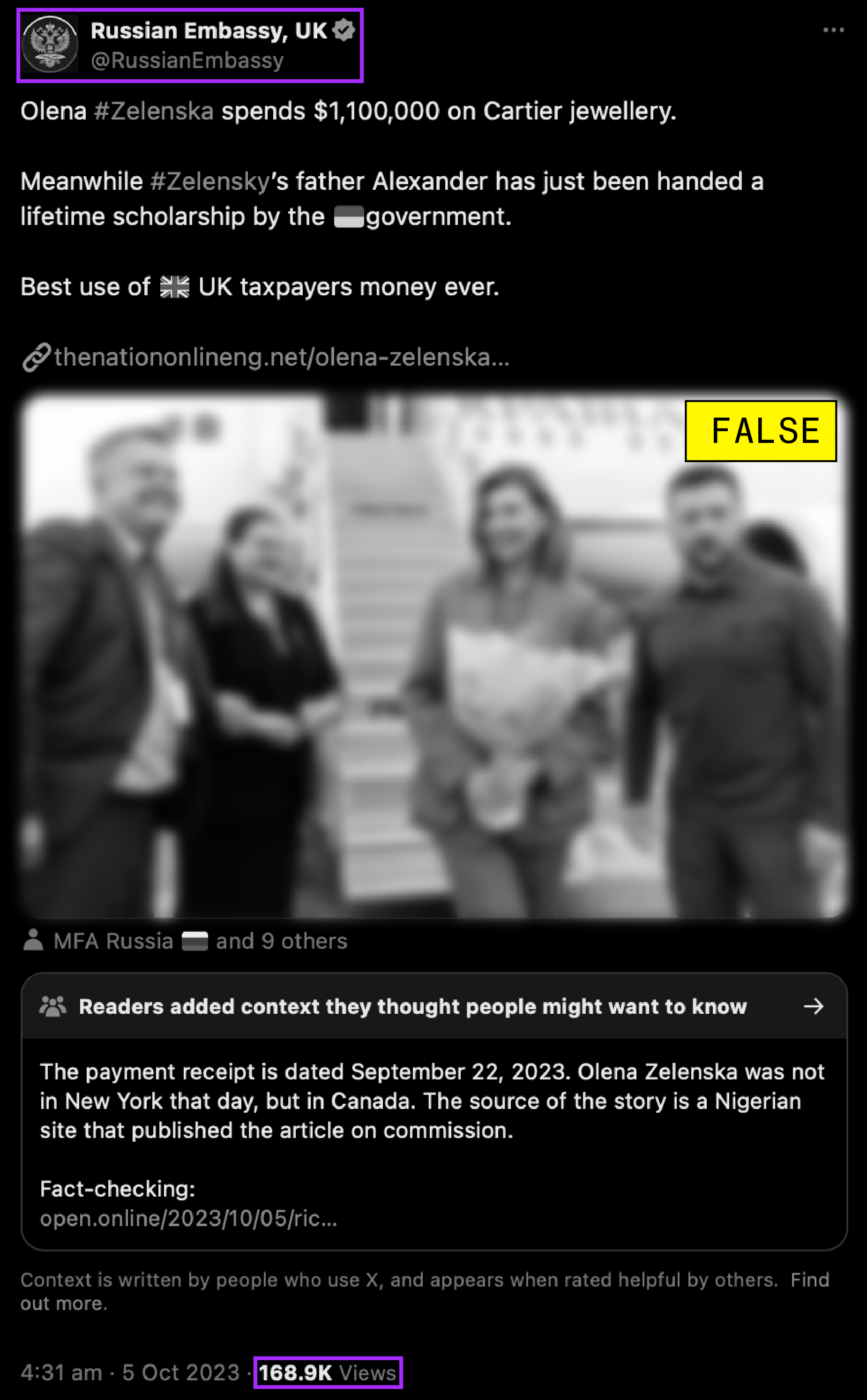 . Others claimed it was an example of how Western aid to Ukraine was being misused. Russian news outlets then reported on the story.
Linvill found other narratives featured on the DC Weekly site aimed at undermining support for Ukraine. They had similar hallmarks: a first-person video on a social media account picked up by African or Middle Eastern news sites, then published by DC Weekly, which pushed it out to other influencers. He didn’t find any narratives before August 2023 that checked all the boxes.
The Storm-1516 Playbook
Video Testimony
Actor’s skin texture and voice suggest AI enhancement
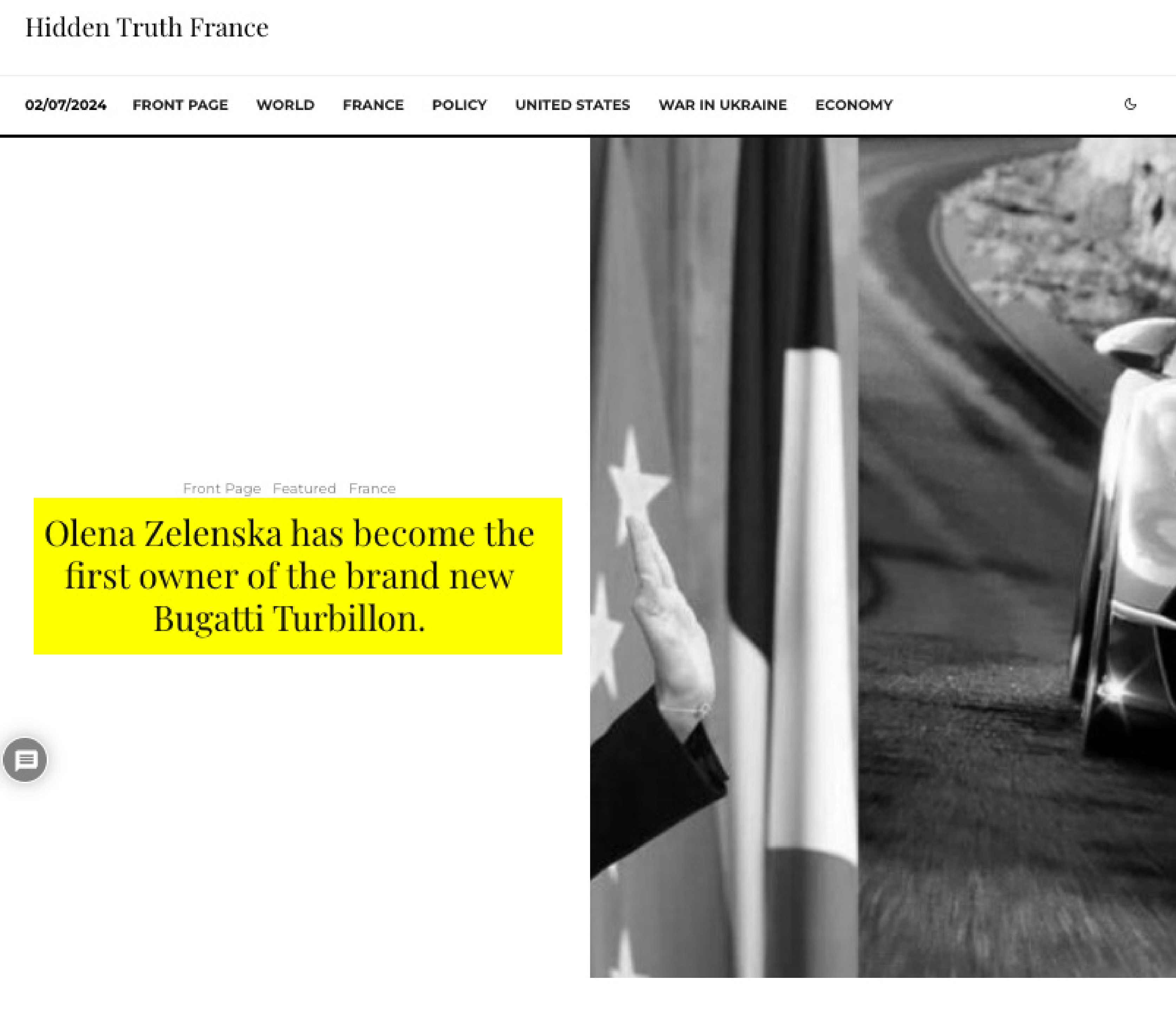
Dubious Websites
The story was posted on a website created nine days earlier
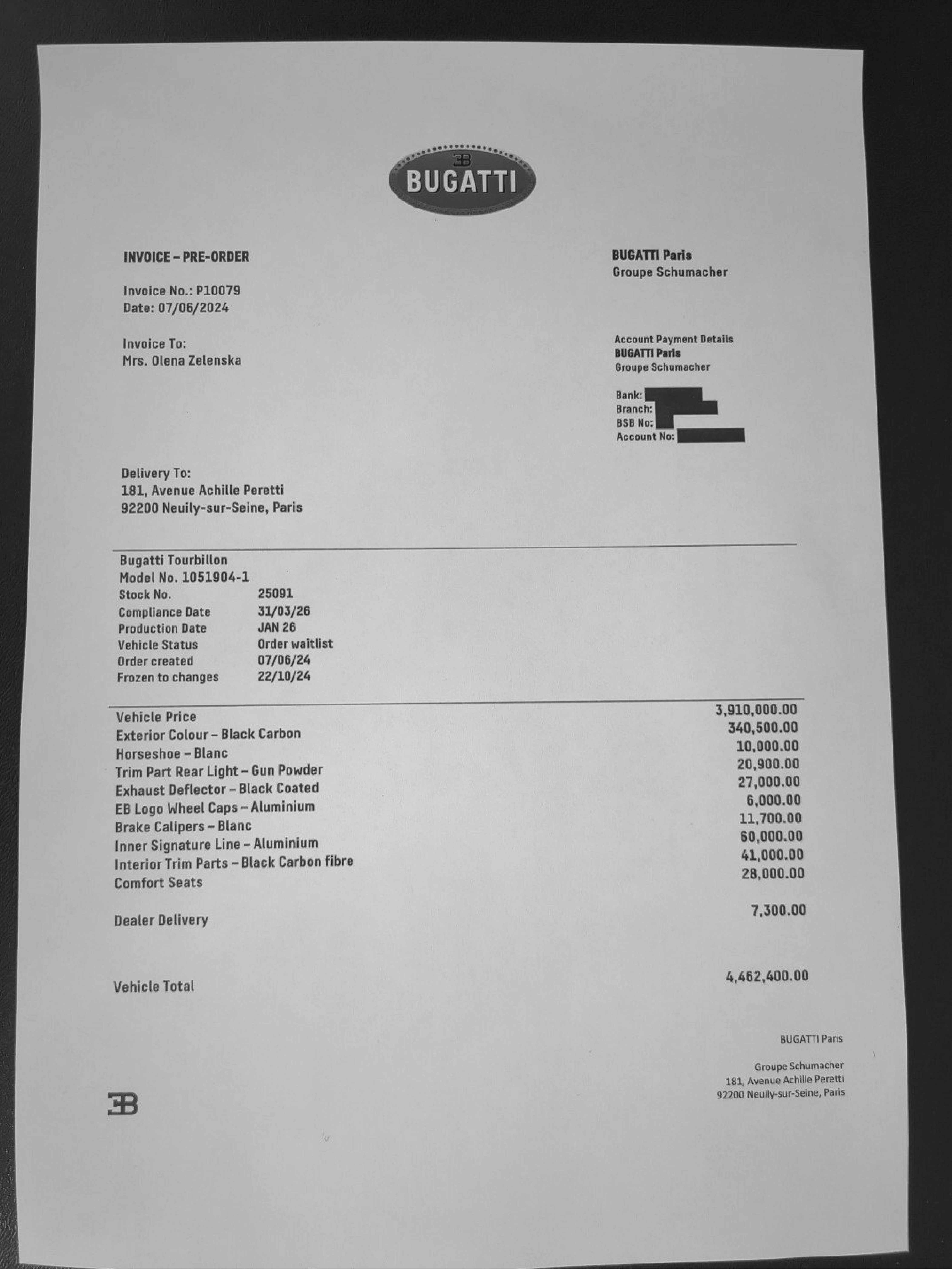
Forged Documents
Doctored receipt has misspellings and omits taxes and currency
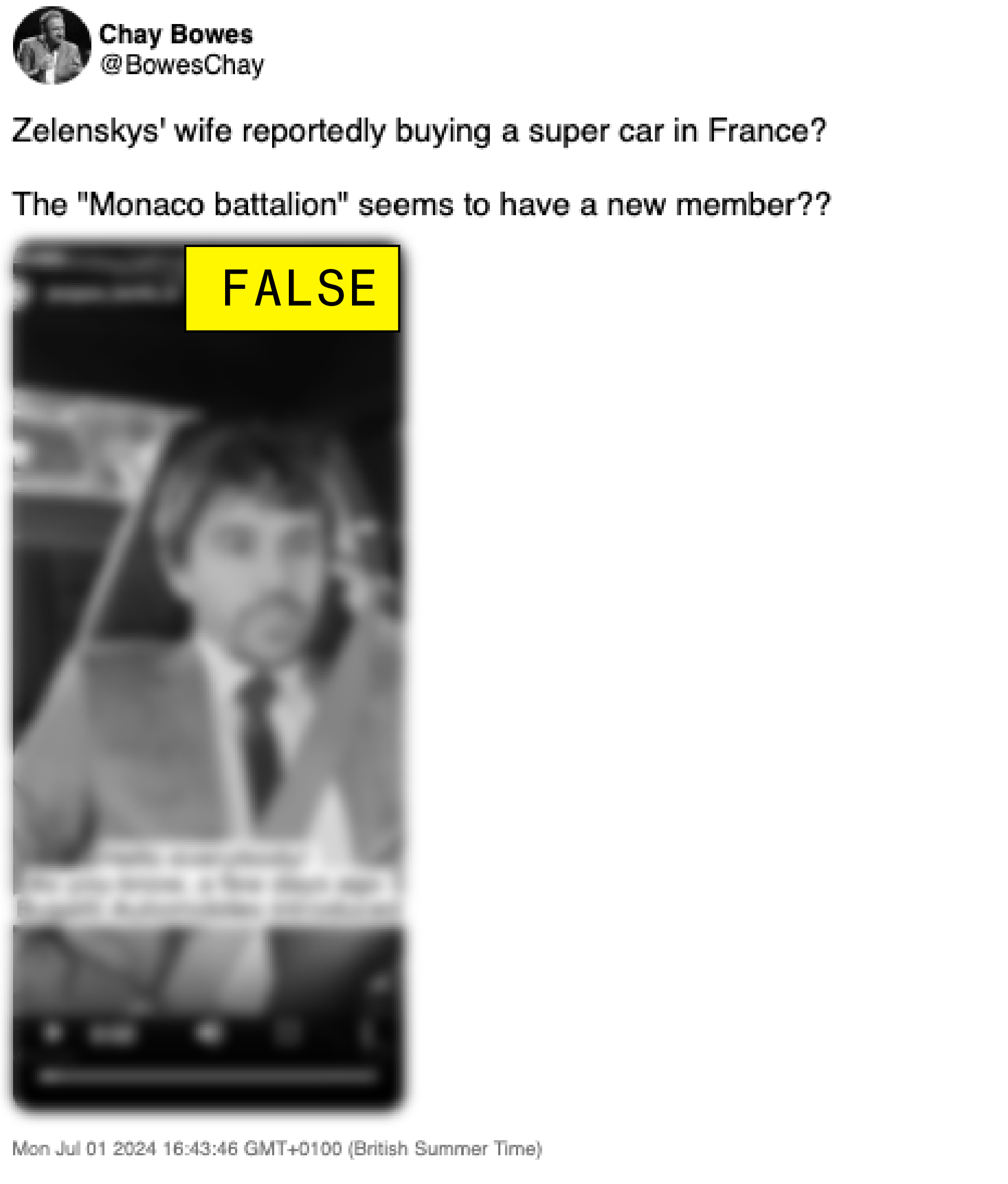
Influencer Posts
This account has shared dozens of Storm-1516 narratives
Linvill calls it narrative laundering — fabricated stories cycled through multiple accounts to hide their origins before slipping into the mainstream conversation — mimicking how illicit money gets washed through layers of offshore companies before entering the regulated financial system. His team has documented how China and Iran also run state-backed disinformation operations to overwhelm the online conversation with narratives supporting Beijing and Tehran.
The best way to measure the impact of sham stories, Linvill says, is to see how they change the conversation online. Before October 2023, the number of posts on X mentioning Zelenska, Zelenskiy and Cartier averaged about 12 a week, according to data compiled by Linvill and his Clemson colleagues. In the week the Cartier story ran, the number of posts mentioning those words surged to 53,000, making up 11% of the total conversation on X mentioning Zelenskiy or Zelenska, the data show. Though the number of posts citing Cartier subsequently fell, users on X continue to repeat the story.
“The story was completely fabricated, but it had an impact on public discourse that most marketing companies would count as a resounding success,” Linvill says. “It painted the Zelenskiys as corrupt and using Western aid money to line their own pockets. What makes it powerful is that it’s followed repeatedly by similar lies, reinforcing the message with a willing audience.”
Since then, stories about Zelenskiy that Bloomberg has identified as Storm-1516 have popped up monthly, sometimes weekly: Zelenskiy 👆 bought land in Wyoming 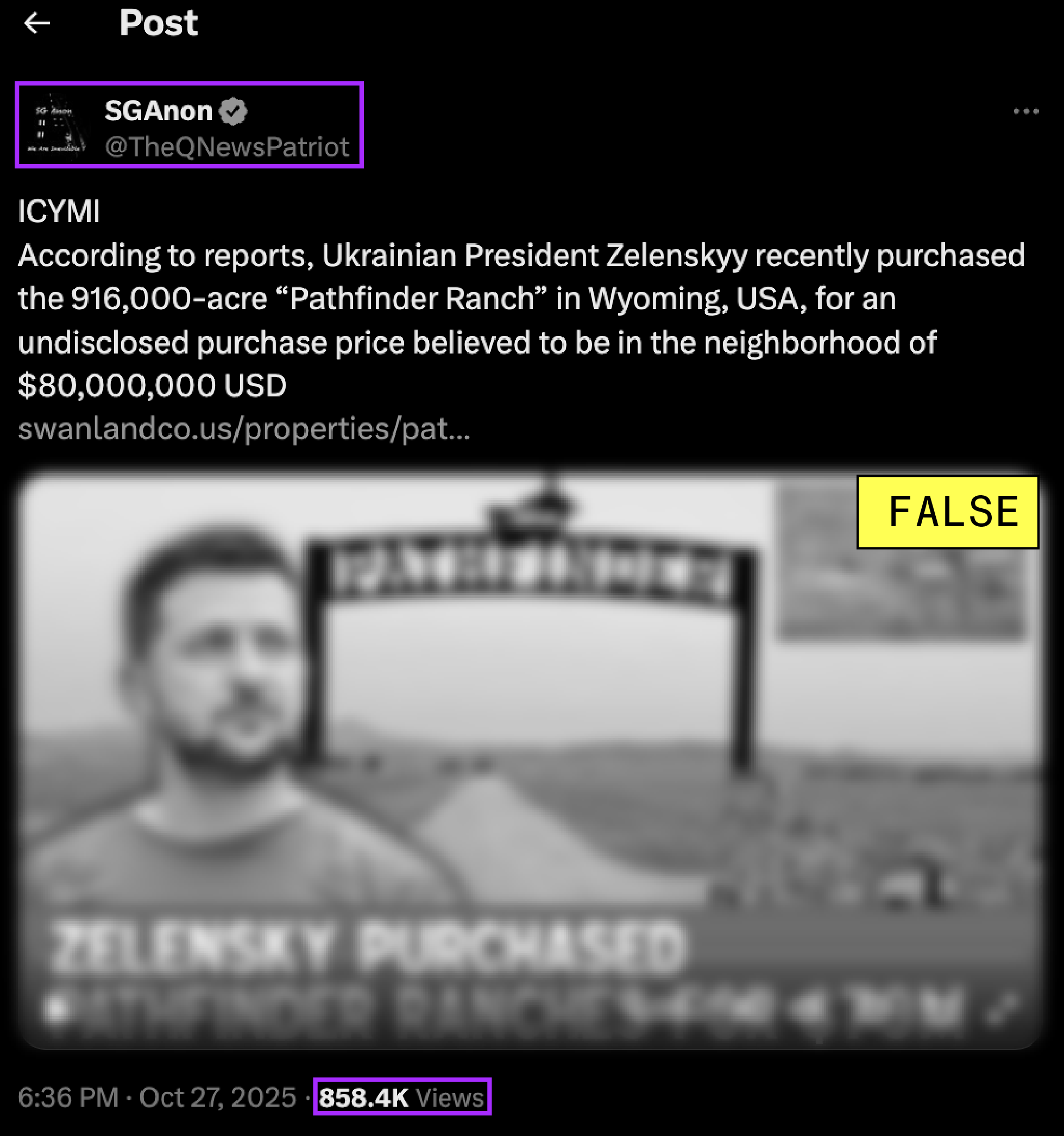 ; Zelenskiy has a Russian passport and an apartment in Moscow; Zelenskiy’s wife spent millions on a Bugatti sports car during a visit to France; Zelenskiy bought an apartment worth $3.2 million in Dubai’s Burj Khalifa for his mother. A recent post claimed the Dubai apartment had been hit 👆 by an Iranian drone.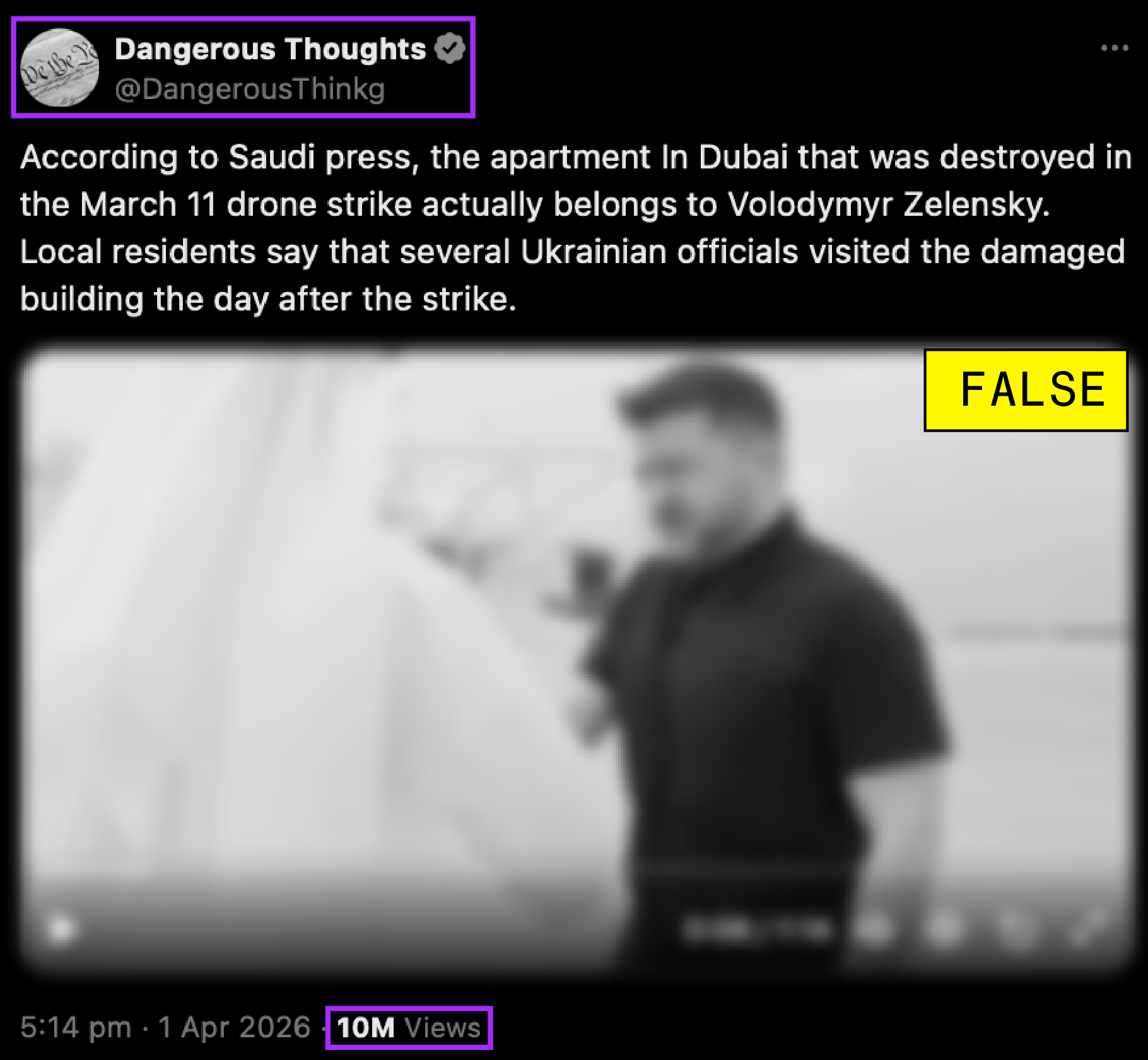
Fact-checkers at news outlets debunked the claims. The Wyoming ranch was sold to an American cattle rancher; the Russian passport photo was a screenshot from a video address just before the 2022 invasion; the Dubai apartment video featured a doctored sale contract. A spokesperson for Zelenskiy said in an email that all of Storm-1516’s narratives about him were fabricated. A spokesperson for Bugatti said the report was fake and that Zelenska is not a customer.
Some of the Ukraine corruption stories have been repeated by US officials. In November 2023, a report alleged that Zelenskiy’s close associates spent $75 million on two yachts using Western aid money. Brokers for the yachts denied they had been sold. But that didn’t stop Vice President Vance, then a senator, from citing it when explaining his opposition to continued US aid to Ukraine. Former Congresswoman Marjorie Taylor Greene also posted the story.
In the run-up to the 2024 US presidential election, the Justice Department unsealed a 277-page FBI affidavit that disclosed strategy memos, emails and internal planning documents for the global disinformation campaign known as Doppelganger.
The documents revealed efforts to depress Biden’s approval rating and erode support for Ukraine. One described a Guerrilla Media Campaign producing three to four videos a day using misleading narratives. “You should continuously repeat that this is what is really happening, but the official media will never tell you about it or show it to you,” the Social Design Agency’s plan stated. The documents called for using “fake videos” and said, “Twitter is the only mass platform that could currently be utilized in the US.”
In October 2024, the Microsoft Threat Analysis Center linked efforts to undermine Democratic nominees Kamala Harris and Tim Walz to Storm-1516. A post with an AI-enhanced video alleging Walz sexually assaulted a student years ago racked up almost 5 million views on X in less than 24 hours, before being deleted. (A spokesperson for Walz didn’t respond to a request for comment.)
In the days leading up to the election, the FBI and other agencies warned that Russia was “manufacturing videos and creating fake articles to undermine the legitimacy of the election,” including one that alleged Haitian immigrants voted illegally in Georgia.
The impact on voter behavior is impossible to quantify. Pollsters avoid questions on debunked claims, and engagement metrics on X can be inflated by coordinated networks and bots. Even so, the reach far exceeded earlier Russian disinformation campaigns.
Combatting foreign disinformation became politically radioactive after Trump rejected intelligence findings that Russia interfered in the 2016 election, branding them a “hoax.” After he won re-election, efforts by the US government to combat Russia’s influence operations ground to a halt. The State Department’s Global Engagement Center, which acted as an interagency hub and issued several reports on Russian disinformation campaigns, ceased operating at the end of 2024 after Congress didn’t renew its mandate.
In February, then-Attorney General Pam Bondi disbanded the FBI’s Foreign Influence Task Force, which sought to expose covert state-backed efforts to shape US public opinion. Although its mission was not aimed at policing the speech of US citizens, that’s how Bondi saw it. She said the task force’s closure would “end risks of further weaponization and abuses of prosecutorial discretion.”
The top US intelligence office effectively dismantled its Foreign Malign Influence Center, which coordinated efforts to counter what it called “subversive, undeclared, coercive or criminal” activities of foreign governments. And in February 2025, the US Cybersecurity and Infrastructure Security Agency, better known as CISA, put a number of employees focused on foreign disinformation on leave. The agency’s acting director, Madhu Gottumukkala, defended those and other CISA cuts at a congressional hearing in January, rejecting criticism from Democrats that the agency was unprepared to fight foreign threats. But in March, Secretary of State Rubio instructed US embassies worldwide to counter foreign propaganda trying to sow division in the US and among allies.
After Trump re-entered the White House, the Russians turned their focus to Europe, where support for continued aid to Ukraine posed the biggest threat. Germany’s backing of Kyiv and sanctions against Russia made the February 2025 German election a key battleground.
Days before the vote, a video spread on X showing a woman’s hands picking postal ballots from a yellow plastic box and feeding those cast for the country’s far-right party, Alternative für Deutschland, or AfD, into a shredder. Ballots for other parties were set aside for counting. The video was shared by Chay Bowes, an Irishman living in Moscow who is a correspondent for RT, a Russian state-controlled broadcaster sanctioned by the US, the EU and the UK. It got half a million views.
But the footage wasn’t real. German officials moved quickly to debunk it, showing that genuine ballots had a different color and lettering. Another video surfaced around the same time, purporting to show ballots that didn’t include the far-right party. An off-camera voice lamented, “This is fraud!” It got millions of views.
Germany’s 2025 Election Was a Key Battleground
The AfD went on to capture almost 21% of the national vote, its strongest showing and double its share four years earlier. The party’s surge in popularity reflected voter discontent over immigration and economic policies and can’t be attributed to any single social media post. Yet the party’s success matched the Kremlin’s goals. In 2023, Russian operatives had set a target to raise the AfD’s polling share to 20%, according to the leaked documents shared with Bloomberg.
Russia also sought to undermine Green Party politician Robert Habeck, who was vice chancellor and economic affairs minister in the previous coalition government and called Russia a security threat to Europe. Turning against his party’s pacifist roots, Habeck said he would approve delivery of long-range Taurus missiles to Ukraine if elected to lead the country, opposing then-Chancellor Olaf Scholz.
In December 2024, a video targeting Habeck appeared on X. It featured a young woman with long dark hair and a grey hooded sweatshirt claiming to be a student at a school northwest of Hamburg.
She alleged that Habeck sexually assaulted her in 2017 when he visited the school. Habeck, a state minister at the time, did visit the school that year and was pictured in the local press alongside a student with that name. But while the woman in the video claims to be that student, they’re not the same person.
The clip, including the audio, had been altered by AI. The woman speaks in German in a voice that sounds synthetic, with a Botox-like expression.
“The skin looks unusually smooth and uniform,” says Oren Etzioni, founder of TrueMedia.org and a professor emeritus at the University of Washington in Seattle who analyzed the video for Bloomberg.
The eyes appear slightly flat and glassy. The gaze alignment is a bit off, which is common in AI video models.
Bloomberg ran the woman’s image through facial recognition software PimEyes. Almost all of the matches that came back were of Russian figure skater Yulia Lipnitskaya, who won a gold medal at the Sochi 2014 Winter Olympics. Lipnitskaya didn’t respond to emails, phone calls and Instagram messages sent to her and the skating school she runs in Russia asking whether her image had been manipulated without her consent. There’s no evidence she knew or approved of the use of her image.
The video first appeared on echozeit.com, a website created only 16 days earlier that has since been taken down. A German-speaking influencer in Switzerland who has shared 40 stories with Storm-1516 characteristics, @daniel_gugger, posted the video on X on Dec. 6, 2024. It garnered 80,000 views in less than five hours, according to Green Party staffers who noticed it and reached out to X to request that it be taken down. The platform removed several posts with the video the same day. But a week later, Gugger re-shared the clip, getting another 19,000 views. It remains on his account, without any community note. The video is blocked in Germany but accessible elsewhere. Gugger didn’t respond to a message seeking comment.
“It is really the worst thing that could happen,” says Habeck. “It’s not the girl who I met years ago. If you’re just a normal user of social media, you see it, you might tend to believe it. And AI makes it harder to find out.”
In December, Germany’s foreign ministry summoned Russia’s ambassador to confront him with evidence of election interference. Officials said they tracked financial transactions and communications tying 10 cases of Russian disinformation to Storm-1516 between July 2024 and July 2025, including the AfD ballot stories. In some cases, they documented the group’s links to Russia’s military intelligence agency.
Storm-1516 has targeted other European supporters of Ukraine. In France, it spread at least 14 narratives, including fabricated corruption claims against President Emmanuel Macron, according to Bloomberg’s analysis. One from October alleged he was spending 148 million euros 👆 on a luxury underground bunker 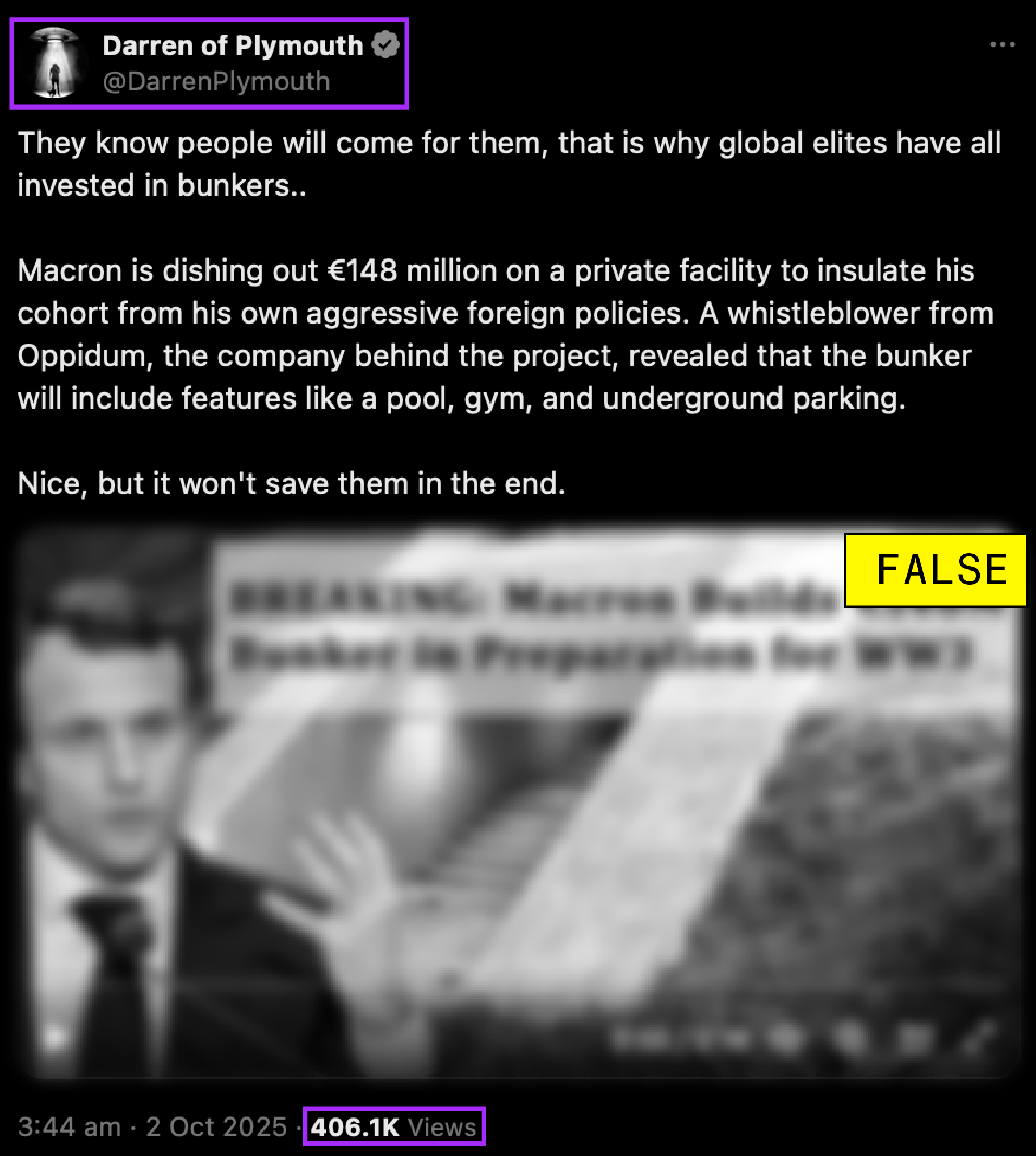 to shelter him in the event of World War III. It cited a forged document showing the transfer of 50 million euros from the Élysée Palace to Oppidum Bunkers GmbH, a Swiss company that went into bankruptcy months before the alleged transaction. Using AI detection tools, Bloomberg found evidence of lip syncing, audio mismatches and face-swap manipulation of a purported company representative.
The story first appeared on Brutinfo, a website mimicking French media outlet Brut.media.fr, and was shared on X by two Francophone accounts that regularly posted Storm-1516 content. Their posts drew more than 7.6 million views before X suspended the accounts and after French authorities publicly flagged them for spreading Russian disinformation. A spokesperson for Macron said he is “taking the issue of foreign interference very seriously.”
Many of the Storm-1516 influencers use pseudonyms with blue checks, making it difficult to determine if they are Kremlin disinformation operatives or ordinary citizens who believe Russian narratives. They often delete posts to cover their tracks. Some influencers have succeeded in drawing established politicians into repeating the stories with predictable outrage.
One account that has shared at least a dozen Storm-1516 clips is @MyLordBebo with 799,000 followers. Its profile picture is a black schnauzer dressed as a Napoleonic-era military officer. The account said it was “anti woke — anti-fake news — anti hypocrisy,” before changing to “trying to be neutral.”
The day after the 2024 US election, @MyLordBebo shared a video claiming Ukrainian soldiers 👆 burned an effigy 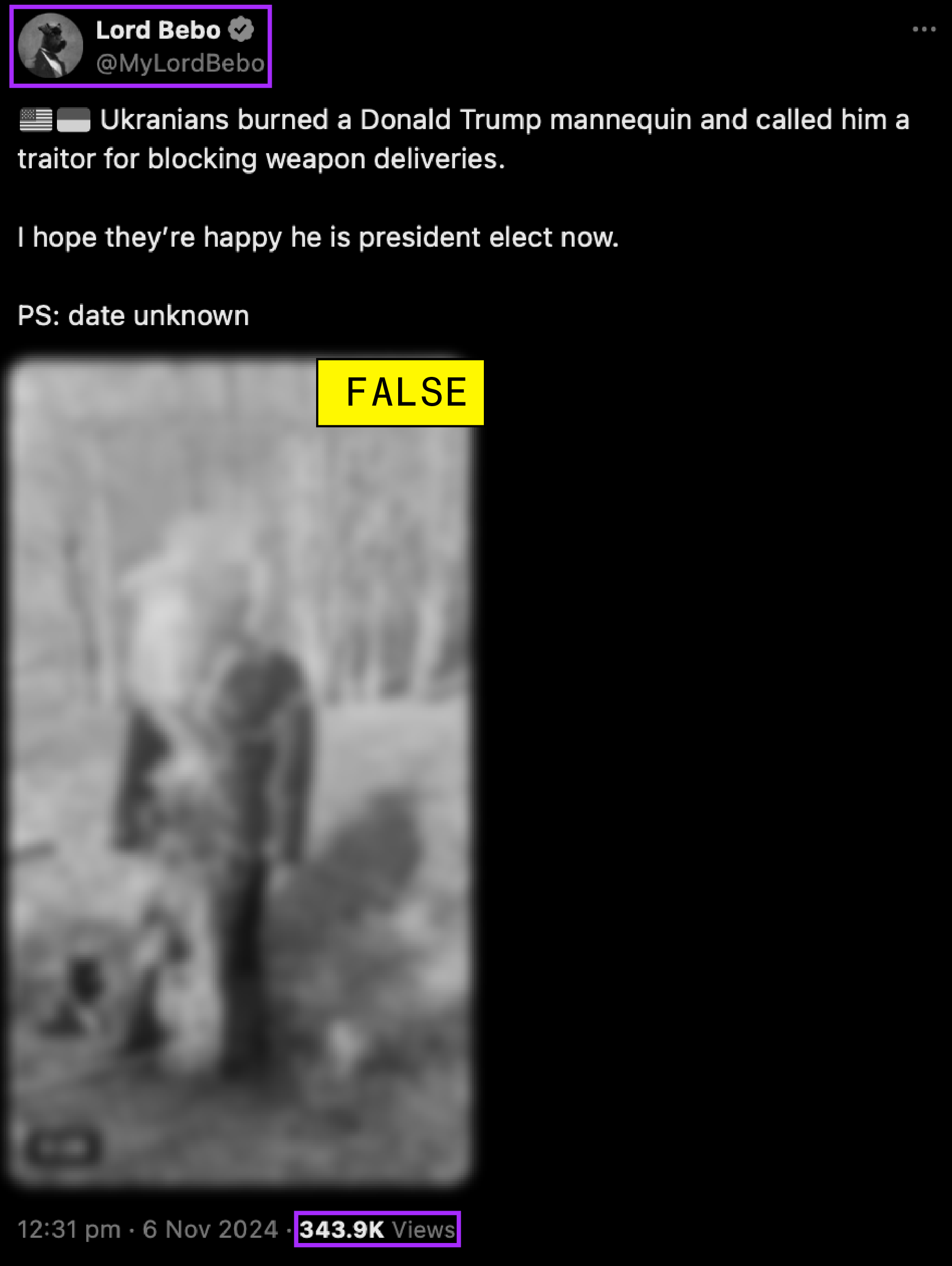 of Trump and called him a traitor. The video was debunked — the voices had Russian accents — but the post got 344,000 views and spread widely. Derrick Evans, a former West Virginia lawmaker who pleaded guilty to felony charges over the Jan. 6, 2021, attack on the US Capitol and was later pardoned by Trump, reposted it, gaining 4.2 million views. Republican Senator Mike Lee of Utah shared Evans’ post, adding, “Not another dime for Ukraine.” Evans and Lee didn’t respond to requests for comment.
@MyLordBebo denied, in a message to Bloomberg, that the account knowingly spread Russian disinformation. “Any wrong posts are just an unintentional mistake,” @MyLordBebo said, pointing to a few instances in which he called out fakes. He said he’d shared content from Gerry Nolan, who runs an X account called @IslanderWORLD, but stopped when he realized the videos had been manipulated. He said he was also sent videos by Aussie Cossack, an Australian pro-Kremlin activist whose real name is Simeon Boikov. He denied taking money, adding that the pair “screwed my reputation up.” The last Storm-1516 story @MyLordBebo shared was in August 2025, Bloomberg’s data show.
Nolan told Bloomberg that he never asked @MyLordBebo to post anything and that he has not received any payments from Russians or anyone else for his work “beyond minimal ‘coffee’ donations” and “X monetization.” Boikov, who was sanctioned by the EU last year for spreading pro-Kremlin misinformation, has been holed up at the Russian consulate in Sydney since 2022 after allegedly assaulting a pro-Ukraine protester. He didn’t respond to requests for comment.
Nolan was previously a partner with Bowes, the Irishman who helped spread the bogus AfD ballot-shredding video. The two ran an account with the handle @IslanderReports that was suspended by X in 2024, but Nolan said they have parted ways. On his own account, Bowes has posted more than 40 narratives produced by Storm-1516 since 2023, according to Bloomberg’s analysis. He also promotes pro-Kremlin views on his weekly Moscow Mules show on Russia’s RT and X.
A former businessman who worked in the health-care industry, Bowes co-founded the Ditch, an Irish investigative news site, in 2021. He left the following year and moved to Moscow. In 2023, Russia invited Bowes and the founder of the website Grayzone, Max Blumenthal, to speak at the UN Security Council, where they both criticized arming Ukraine.
In May 2025, Romanian authorities blocked Bowes from entering the country on a flight from Dublin after learning of his plans to meet with pro-Russian influencers coordinating disinformation campaigns ahead of Romania’s election.
Bowes often posts about his travels to Dublin, and he went to Hungary ahead of the election there. EU sanctions prohibit Bowes from broadcasting or facilitating the distribution of RT-produced content in the bloc.
Bowes said in an email that he has “no association with any ‘influence operation’” and has never been paid to post anything. He said he was challenging Romania’s entry ban and denied he planned to meet anyone in the country. He didn’t respond to questions about his relationship with RT. Nor did RT.
The broader aim of Russia’s disinformation campaign is to undermine support for Ukraine and divide the West by eroding trust in democratic institutions and elections. With the US midterms looming, that strategy is likely to intensify.
“In a lot of these elections, you don’t need big numbers — you need targeting and that’s what the Russians do,” says Anne Nelson, a research fellow at the Arnold A. Saltzman Institute of War and Peace Studies at Columbia University. Nelson points out that the makeup of the 2024 House of Representatives was determined by 7,309 votes in three districts. “The dismantling of government agencies tracking disinformation,” she says, “is the equivalent of saying, ‘Come on in.’”
(Adds comment from Johnny Midnight account in sixth paragraph.)