
One Calf Shows Why Record Beef Prices Still Aren’t Coming Down
Pressures at every stage of the 18-month supply chain are expected to keep prices high at least through year end
If you’ve bought beef lately, you’ve felt it: Prices are more expensive than ever. The average cost for ground beef – typically the cheapest option in the meat case – is now averaging a record nearly $7 a pound.
The basic reason is straightforward enough. The US cattle herd is the smallest it’s been in decades, squeezed by drought and high feed costs. Demand for beef, meanwhile, has held up.
That hasn’t stopped the fingerpointing, though, with politicians making the protein a key issue ahead of midterm elections. Top Trump administration officials on Monday laid a large part of blame for high prices on meatpackers, with the Justice Department confirming it was investigating potential antitrust violations in the industry. At the same time, Tyson Foods Inc. – the country’s biggest processor – reported yet another quarterly loss in its beef business, showing the companies aren’t profiting from the lofty prices.
The reality behind expensive beef is complicated. There’s no quick fix for tight supplies, as the sticker shock in the grocery aisles didn’t happen overnight. It’s not just that the animals take a long time to grow. The complicated economics of cattle ranching also create pain points at key stages of production.
Consumer Prices Reflect Supply Chain’s High Costs, Low Profit
Source: Hyrum Egbert
Note: Data for week ending April 18.
To understand why the US’s hamburgers and steaks cost so much now, Bloomberg News followed a hypothetical animal as it moved through the hands of three ranchers, a meatpacker, a grocer and finally into the hands of the consumer. Its profitability will shift with each handoff through the long supply chain.
Those margins at every step help explain why the US cattle herd has shrunk to a 75-year low, with little sign of a meaningful rebound – and why, despite President Donald Trump’s urging that Americans “just hold on a little while,” high beef prices are likely to stick around for the rest of the year.
Operating costs
Price received for one animal
Profit
Cow-calf ranch
September 2024
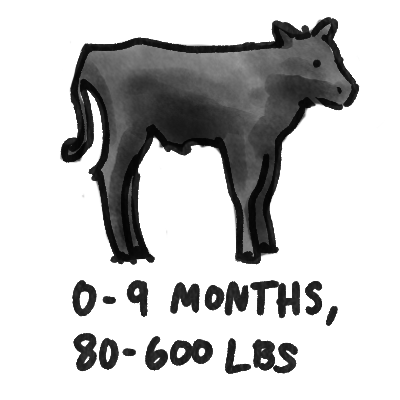
Droughts Decimated Cattle Population at the Start of the Supply Chain
Our hypothetical calf was born roughly a year and a half ago. It is likely part of a small herd – most so-called cow-calf operations have fewer than 50 cattle – and its owner, as always, has two options: to sell the animal further into the meat supply chain, or to raise it for breeding later on.
The calculus, at this time, is in favor of selling off the animal as soon as possible. A drought is deepening across much of the US’s cattle area, giving the calf less grass to graze on and requiring the rancher to spend more on feed. The cattle herd more broadly is shrinking nationwide as other ranchers have made that same decision, pushing up the value of our calf.
Share of Cattle Affected by Dryness
0
75%
2016
2026
Cow-calf ranch
Source: National Drought Mitigation Center
Note: Includes abnormal dryness to exceptional drought conditions.
If the rancher decided to raise it for breeding, they would be buying feed for longer for an animal whose offspring in two years might be worth far less. Other inputs like farm equipment have become pricier as well, and the costs of financing those purchases have also risen due to higher interest rates.
Total Annual Interest Expenses For Farmers
10B
$30B
2017
2026
Cow-calf ranch
Source: US Department of Agriculture
Note: Expenses include operator dwellings. 2025 and 2026 are forecasted values.
Cow-calf producers carry a great deal of risk, because many are small operators and because they hold onto their animals for the longest time our calf will stay anywhere along the supply chain, said Hyrum Egbert, an expert who has worked in the industry for nearly two decades and modeled the figures used throughout this article. During that time, prices could collapse, or droughts and disease could threaten herds.
“It’s important to understand that there are a lot of years where we’re not profitable,” said Janie VanWinkle, a fourth-generation cow-calf rancher in Colorado. “We are experiencing record high prices, absolutely, but not only are we paying higher input prices, we’re also trying to bank a little bit on the future because we know these cattle prices aren’t going to last forever.”
So these operators – currently by far the most profitable players in our scenario as others compete for the young cattle – will sell this animal further into the meat supply chain. The calf is weaned from its mother and becomes a heifer, a young female cow that hasn’t given birth.
Price paid for one animal
Operating costs
Price received for one animal
Profit
Stocker ranch
June 2025
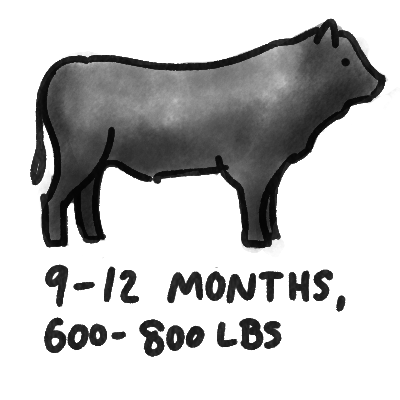
Stockers Raise Animals Further
Nine months later, a cattle stocker, also known as a backgrounder, will continue to let our animal graze, sometimes with supplemented grains or feed additives to boost health, for three months until it is about 800 pounds. In other times, it may have been joined by cattle imported from Mexico, but those shipments have been largely halted since last fall as the US tries to prevent the deadly New World screwworm from traveling north. The disease, which was eradicated from the US decades ago, is capable of killing grown animals in just days.
Monthly Heads of Cattle Imported from Mexico
0
100K
2016
2026
Stocker ranch
Source: US Department of Agriculture
Note: Live shipments were first halted in November 2024 and briefly resumed for part of 2025.
That trade doesn’t appear likely to resume any time soon, even as those imports are seen by some in the industry as the fastest way to improve meatpacking margins and lower consumer prices. Detections of the parasite have recently accelerated in Mexico, with more than 1,000 cases reported in April. Some cases are as close as 60 miles away from the border, lowering chances that the US Department of Agriculture might attempt resuming that trade in phases.

Price paid for one animal
Operating costs
Price received for one animal
Deficit
Feedyard
September 2025
Feedyard Margins Start Tightening Despite Cheap Grain
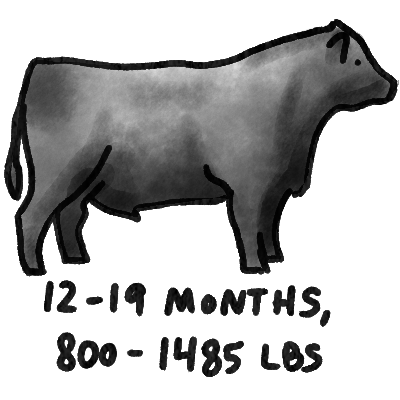
Our animal, now about a year old, is next sold to a feedlot where it is put on a grain-heavy diet that allows it to gain as much as four pounds a day. While the heifer is expensive, its feed, thankfully for the rancher, is relatively cheap as US farmers have been producing bumper crops.
Average Price Received By Farmers
100
$250 per ton
2016
2026
Hay
Corn
Feedyard
Source: US Department of Agriculture
Note: Values are not adjusted for inflation.
The animal is likely sold at a high price too, as meatpackers in the next step along the chain scramble to procure enough animals to keep their plants running profitably. In March, the number of cattle placed into feedlots and shipped to slaughter markets were both at the second-lowest for the month in USDA data going back three decades.
Monthly Heads of Cattle Shipped to Slaughter Markets
1.5M
2M
2016
2026
Feedyard
Source: US Department of Agriculture
Note: Data are for feedlots with a capacity of over 1,000 heads of cattle.
For some time early in the cattle shortage, the gap between the cheaper calves that these ranchers bought and the expensive, ready-for-slaughter animals they sold led to some profits. But some of these cattle feeder operations have also come under greater pressure as they have few animals to buy from stockers and cannot buy directly from Mexico. Lubbock Feeders, a 70-year-old Texas feedyard that can hold as much as 50,000 animals, most of which used to come from Mexico, said earlier this year that it will shut down once it works through its existing inventories.

Price paid for one animal
Operating costs
Price received for one animal
Deficit
Meatpacker
April 2026

Meatpackers Forced to Pay Up For Scarce Supplies
Our animal meets its end at the slaughterhouse, after being sold from the cattle feeder to a meatpacker through what is usually a forward contract, unlike sales earlier in the supply chain that are often at open auctions. This practice has in the past drawn scrutiny for its lack of transparency, with ranchers feeling like they have no control over the prices they get. The heavily concentrated meatpacking industry, with four firms accounting for 85% of cattle purchases, is a natural magnet for scrutiny whenever beef prices go up. Last fall the Trump administration announced an antitrust probe into the industry, after a similar Biden-era probe had already closed. Democratic senators also earlier this year proposed legislation to restrict companies to only processing one type of meat. But beef processors have been losing money as they compete for scarce cattle.
Beefpacking Margins Per Animal Processed
-500
0
$1K
2016
2026
Meatpacker
Source: HedgersEdge via Bloomberg
“I stay awake and have stayed awake a lot of nights trying to figure out the answer to that,” Tyson Foods CEO Donnie King said on a Monday earnings call about the herd problem. “What I do have the answer for is us controlling what we can control, and that’s what we’re doing.” The company closed a plant in Nebraska earlier this year and reduced operations at a Texas facility. Cargill Inc. and JBS NV have also said they would close plants in Milwaukee and California, respectively.
While there are fewer cattle, they are likely bigger than those in years past. Our animal has improved genetics, and its feedyard might have held onto it for longer to fetch returns on a few extra pounds.
Commercial Cattle Slaughter Average Dressed Weight
800
900 pounds
2016
2026
Source: US Department of Agriculture
Note: Dressed weight includes an animal’s usable meat, bones and fat, after other parts like its hide and organs have been removed.
This is good for the consumer, as it means US beef production hasn’t plummeted nearly as much as the US herd has. That has helped meet a shift in US consumption toward the relatively cheaper product. But that isn’t necessarily good for the meatpacker, as every animal only contains so many steaks, said Brian Earnest, lead economist for animal protein at CoBank ACB.
Price paid for one animal
Operating costs
Price received for one animal
Profit
Grocers
April 2026

Grocers Pass On Costs to Protein-Crazed Shoppers
Cuts of meat from our animal will be distributed to grocery stores, where American consumers first intersect with the long supply chain. The prices on those shelves have continually topped records, but US consumption per capita is still set to be the highest in more than 15 years. Consumers have been shifting toward high-protein, low-cost foods. Simple ground beef meals with rice and vegetables have gone viral on TikTok, where they’ve been deemed “boy kibble” for bearing a resemblance to dog food. The Trump administration also recently flipped the food pyramid to prioritize protein, including beef.
Middle-income shoppers at grocer Albertsons Co. are shifting from steak to ground beef, Chief Executive Officer Susan Morris said in a January earnings call. Spending among higher-income customers is “largely stable, but also, we are starting to see them be increasingly value-conscious,” she said.
Annual Beef Supply Per Capita
50
60 pounds
2010
2026
Grocers
Source: US Department of Agriculture
Note: 2026 annual number is a projection as of April.
Resilient demand for beef has allowed big retailers to stay on the winning side of these sales, while meatpackers lose out, as larger accounts have leverage to negotiate their pricing, said David Anderson, an agricultural economics professor at Texas A&M University. But they are also toeing the line carefully so budget-conscious consumers don’t pull back further. Retailers are purchasing and advertising either cheaper cuts, or higher premium products to steal occasions away from restaurant dining, said Anshul Gupta, a managing director at LEK Consulting, which advises grocers.
A similar pattern is happening for foodservice accounts like restaurants, which make up the rest of meatpackers’ customer base. Dishes that put the focus on ground beef like hamburgers are having a moment, while more affordable steaks are getting quality upgrades thanks to different cooking techniques. Fast-food spots are running promotions for cheaper proteins like chicken.

Price paid for one animal
Consumers
April 2026

Near-Record Prices Set to Stick For Longer
All this means there are few quick fixes for near-record beef prices.
Average Price for Beef
3
$10 per pound
2016
2026
Steaks
Ground beef
Source: US Bureau of Labor Statistics Consumer Price Index
Note: Data is not seasonally adjusted. Data not available for October 2025 due to lapse in appropriations.
The fastest boost will come from imports, which Trump has encouraged by allowing more shipments from countries like Argentina. Consumer ground beef prices dipped modestly in March for the first time in over a year, according to the US Bureau of Labor Statistics. While the decline was near negligible, it could be an early signal that the foreign imports flowing into the country are starting to ease tight domestic supplies.
Monthly US Imports of Beef and Beef Products
50K
200K metric tons
2020
2026
Source: US Department of Agriculture
But because those supplies are largely lean trimmings that get blended into ground beef, the fundamental fix for the US’s love of beef will need to come from within. That rebuild hasn’t begun in earnest yet. The US cattle herd as of Jan. 1 was still at its lowest since 1951. The number of beef replacement heifers that are meant to give birth to new calves only grew 1% from the past year.
January Cattle and Calves Count
85M
95M
2016
2026
Source: US Department of Agriculture
That’s as the factors at the very beginning of this supply chain still hold true. In 2024, producers were trying to “re-heal the balance sheet,” paying down losses and debt, said Fallon Savage, a senior vice president at Farm Credit, a national network of lenders. Last year provided some room to invest in the future, and only this year has it become more of a possibility to consider keeping more animals for breeding, Savage said.
But production costs remain elevated and the drought, again, is deepening – making that more difficult to do. Cow-calf ranchers continue to see record returns, which could be upwards of $1,100 to $1,200 per cow this year and next year, according to estimates from the Livestock Marketing Information Center. The risk of plunging prices, which happened following a rapid herd expansion a decade ago, has also cautioned ranchers against a fast rebuild.
The profitability of the cow-calf producer and the resilience of demand are “the two extremes of the market that to me are just abnormalities, and that leaves everybody in between as all margin players,” said Don Close, a senior animal protein analyst at Terrain Ag. “That’s just a dog fight for survivability and positioning until we find some kind of balance between the limited supply going in and the strong demand going out.”