Ukraine Rebuilds Its Energy Grid With Lessons From the Frontline
On the day of the full-scale invasion, Victoria Polkovnikova took one of the last trolleybuses into Kharkiv. Others were fleeing west as Russian forces advanced towards the city, but Polkovnikova felt she had to be at her post, an electrical substation in the center.
As rockets and bombs fell, she tried to keep the equipment running. The first few days were terrifying, said Polkovnikova.

Nighttime Lights intensity
Autumn 2021
Autumn 2024
Aircraft
manufacturing
facility
Shopping
mall
Kharkiv
National
university
TEC-5 heat and
power plant
Football
stadium
Industrial
area
International
airport

Nighttime Lights intensity
Autumn 2021
Autumn 2024
Aircraft
manufacturing
facility
Shopping
mall
Kharkiv
National
university
TEC-5 heat and
power plant
Football
stadium
Industrial
area
International
airport

Nighttime Lights intensity
Autumn 2021
Autumn 2024
Aircraft
manufacturing
facility
Shopping
mall
Kharkiv
National
university
TEC-5 heat and
power plant
Football
stadium
Industrial
area
International
airport

Nighttime Lights intensity
Autumn 2021
Autumn 2024
Aircraft
manufacturing
facility
Shopping
mall
Kharkiv
National
university
Football
stadium
TEC-5 heat and
power plant
Industrial
area
International
airport

Nighttime Lights intensity
Autumn 2021
Autumn 2024
Aircraft
manufacturing
facility
Kharkiv
Shopping
mall
National
university
TEC-5 heat and
power plant
Football
stadium
International
airport

Nighttime Lights intensity
Autumn 2021
Autumn 2024
Aircraft
manufacturing
facility
Shopping
mall
National
university
Kharkiv
TEC-5 heat and
power plant
Football
stadium
International
airport

Nighttime Lights intensity
Autumn 2021
Autumn 2024
Aircraft
manufacturing
facility
Shopping
mall
National
university
Kharkiv
Football
stadium
International
airport

Nighttime Lights intensity
Autumn 2021
Autumn 2024
Aircraft
manufacturing
facility
Shopping
mall
Kharkiv
National
university
Destroyed in
March 2024
TEC-5 heat and
power plant
Football
stadium
Industrial
area
International
airport

Nighttime Lights intensity
Autumn 2021
Autumn 2024
Aircraft
manufacturing
facility
Shopping
mall
Kharkiv
National
university
Destroyed in
March 2024
TEC-5 heat and
power plant
Football
stadium
Industrial
area
International
airport

Nighttime Lights intensity
Autumn 2021
Autumn 2024
Aircraft
manufacturing
facility
Shopping
mall
Kharkiv
National
university
Destroyed in
March 2024
TEC-5 heat and
power plant
Football
stadium
Industrial
area
International
airport

Nighttime Lights intensity
Autumn 2021
Autumn 2024
Aircraft
manufacturing
facility
Shopping
mall
Kharkiv
National
university
Destroyed in
March 2024
Football
stadium
TEC-5 heat and
power plant
Industrial
area
International
airport

Nighttime Lights intensity
Autumn 2021
Autumn 2024
Aircraft
manufacturing
facility
Kharkiv
Shopping
mall
Destroyed in
March 2024
National
university
TEC-5 heat and
power plant
Football
stadium
International
airport

Nighttime Lights intensity
Autumn 2021
Autumn 2024
Aircraft
manufacturing
facility
Shopping
mall
Destroyed in
March 2024
National
university
Kharkiv
TEC-5 heat and
power plant
Football
stadium
International
airport

Nighttime Lights intensity
Autumn 2021
Autumn 2024
Aircraft
manufacturing
facility
Shopping
mall
National
university
Kharkiv
Football
stadium
International
airport
Over the next two-and-a half months, Polkonikova, who was 49 at the time, worked what she calls her “longest shift,” leaving the facility only to pick up food. Then, as the city adjusted to the new reality, and colleagues returned to their jobs in mid-May, she finally went home. “It was dangerous to move around, so I stayed at my substation,” she said. “Our substation, although old, is very reliable. I even built myself a shelter, without windows and behind thick walls.”
Attacks on power infrastructure have become a feature of Russia’s attempts to conquer Ukraine. Since the start of the full-scale invasion in February 2022, 63,000 pieces of energy infrastructure have been damaged, according to the Energy Ministry, which estimates the cost of the damage to the sector to be $93 billion. On 30 separate occasions, Russia has launched huge, coordinated strikes on power stations and substations, using drones, cruise missiles and airstrikes to try to break the grid. Kharkiv, a major economic and cultural hub for the east of the country, has been a regular target. In March 2024, the giant Zmiiv power plant close to the city was destroyed, plunging thousands of people into darkness.
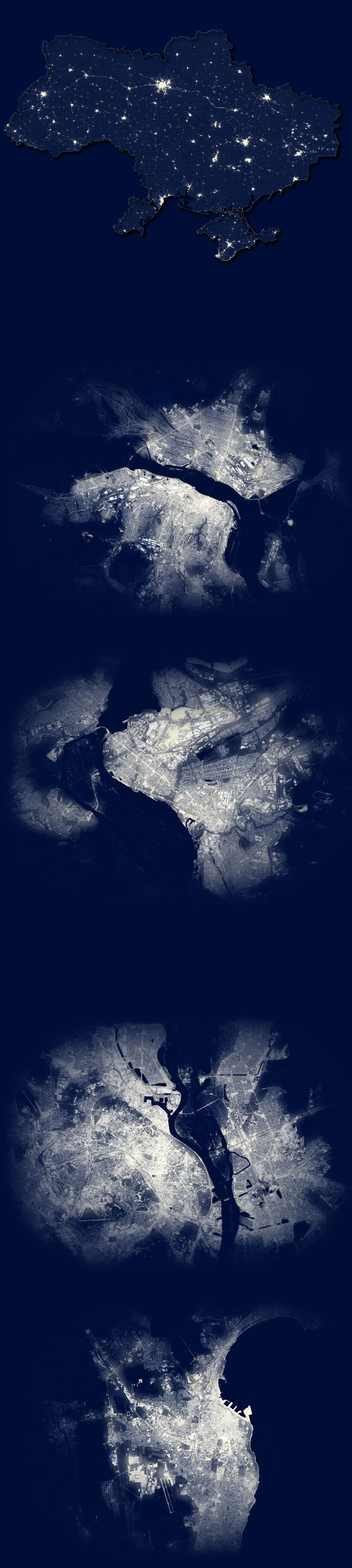
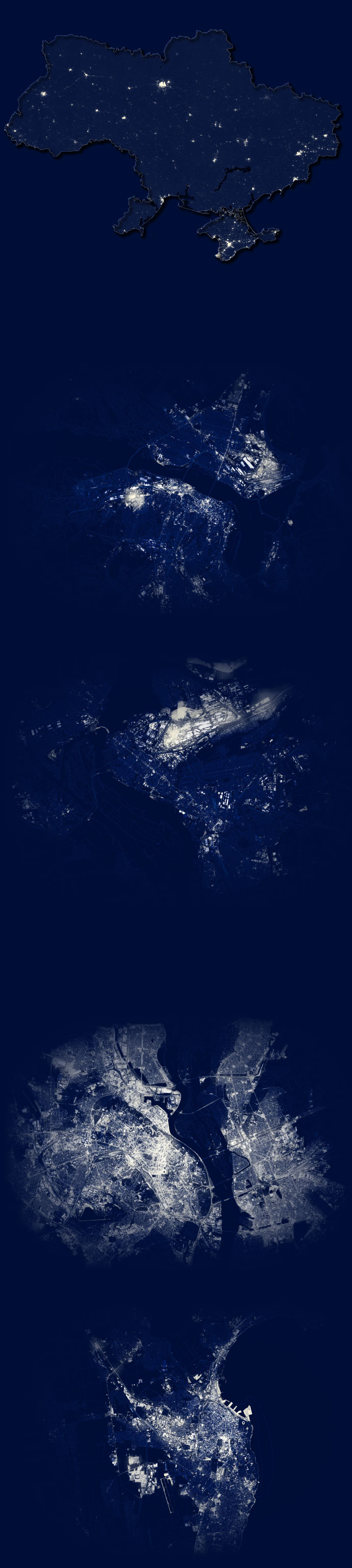
A Bloomberg News analysis of satellite imagery collected by NASA found that Kharkiv City experienced a 94% drop in the intensity of nighttime lights in the autumn of 2024 when compared to three years before Russia’s invasion. The northeast Ukrainian city’s dramatic change in satellite-detected lighting ranks third of all cities, urban areas and other communities, after Nikopol and Avdiyivka.
As the war has dragged on, though, the disruptions have been shorter. Total blackouts are a rarity, even after major strikes. That’s because the grid has been reengineered to be less reliant on massive Soviet-era thermal power stations, and more distributed and diverse in its sources. Cities across the country have built their own independent generation networks using small-scale gas turbines and renewables that can keep critical services running when the grid comes under attack. Although not anywhere near pre-war levels, many cities across Ukraine have restored some night-light intensity. The current intensity doesn’t necessarily reflect total capacity, since some residents may be keeping lights off at night for fear of attacks.
Lights Dim Over Ukrainian Cities

UKRAINE
Kyiv
Kharkiv
Dnipro
Zaporizhzhia
Odesa
Dnipro
Intense fighting along the front line severely damaged energy infrastructure in these cities, causing the most significant nighttime dimming
Zaporizhzhia
Though severely damaged early on, these cities further from the front line show evidence of grid repair and more light recovery amid less persistent attacks
Kyiv
Odesa

UKRAINE
Kyiv
Kharkiv
Dnipro
Zaporizhzhia
Odesa
Dnipro
Intense fighting along the front line severely damaged energy infrastructure in these cities, causing the most significant nighttime dimming
Zaporizhzhia
Though severely damaged early on, these cities further from the front line show evidence of grid repair and more light recovery amid less persistent attacks
Kyiv
Odesa

UKRAINE
Kyiv
Kharkiv
Dnipro
Zaporizhzhia
Odesa
Dnipro
Intense fighting along the front line severely
damaged energy infrastructure in these cities,
causing the most significant nighttime dimming
Zaporizhzhia
Though severely damaged early on, these cities
further from the front line show evidence of grid repair
and more light recovery amid less persistent attacks
Kyiv
Odesa

UKRAINE
Kyiv
Kharkiv
Dnipro
Zaporizhzhia
Odesa
Intense fighting along the front line severely
damaged energy infrastructure in these cities,
causing the most significant nighttime dimming
Dnipro
Zaporizhzhia
Though severely damaged early on, these cities
further from the front line show evidence of grid repair
and more light recovery amid less persistent attacks
Kyiv
Odesa
UKRAINE
Kyiv
Kharkiv
Dnipro
Zaporizhzhia
Odesa
Intense fighting along the front line severely
damaged energy infrastructure in these cities,
causing the most significant nighttime dimming
Dnipro
Zaporizhzhia
Though severely damaged early on, these cities
further from the front line show evidence of grid
repair and more light recovery amid less
persistent attacks
Kyiv
Odesa

UKRAINE
Kyiv
Kharkiv
Dnipro
Zaporizhzhia
Odesa
Dnipro
Intense fighting along the front line severely damaged energy infrastructure in these cities, causing the most significant nighttime dimming
Zaporizhzhia
Though severely damaged early on, these cities further from the front line show evidence of grid repair and more light recovery amid less persistent attacks
Kyiv
Odesa

UKRAINE
Kyiv
Kharkiv
Dnipro
Zaporizhzhia
Odesa
Dnipro
Intense fighting along the front line severely damaged energy infrastructure in these cities, causing the most significant nighttime dimming
Zaporizhzhia
Though severely damaged early on, these cities further from the front line show evidence of grid repair and more light recovery amid less persistent attacks
Kyiv
Odesa

UKRAINE
Kyiv
Kharkiv
Dnipro
Zaporizhzhia
Odesa
Dnipro
Intense fighting along the front line severely
damaged energy infrastructure in these cities,
causing the most significant nighttime dimming
Zaporizhzhia
Though severely damaged early on, these cities
further from the front line show evidence of grid repair
and more light recovery amid less persistent attacks
Kyiv
Odesa

UKRAINE
Kyiv
Kharkiv
Dnipro
Zaporizhzhia
Odesa
Intense fighting along the front line severely
damaged energy infrastructure in these cities,
causing the most significant nighttime dimming
Dnipro
Zaporizhzhia
Though severely damaged early on, these cities
further from the front line show evidence of grid repair
and more light recovery amid less persistent attacks
Kyiv
Odesa
UKRAINE
Kyiv
Kharkiv
Dnipro
Zaporizhzhia
Odesa
Intense fighting along the front line severely
damaged energy infrastructure in these cities,
causing the most significant nighttime dimming
Dnipro
Zaporizhzhia
Though severely damaged early on, these cities
further from the front line show evidence of grid
repair and more light recovery amid less
persistent attacks
Kyiv
Odesa
Source: Bloomberg News analysis of NASA Black Marble satellite imagery
Under fire, Ukraine has built a system that is more resilient — and greener — than what it had before, and created a blueprint for the future that the government and energy companies hope will attract at least some of the investment the energy sector requires, even if a US-brokered peace deal doesn’t come to fruition.
“The main challenge for Ukraine is to combine the urgent needs to supply electricity and be more resilient to new Russian attacks, and to think about how to develop and rebuild our system,” Olena Lapenko, energy security expert at the DiXi Group, an energy think tank in Kyiv, said. The grid needs to be more decentralized, more flexible, more efficient, and hardened against future threats. “We have to redesign everything, starting from the model of the energy system, and finishing with the equipment.”
At the beginning of 2022, Ukraine’s electricity grid was made up of Soviet-era transmission lines, and supplied mostly by large nuclear, coal-fired and gas power stations. A single power plant, the Zaporizhzhia nuclear power station in the southeast, supplied nearly a quarter of the country’s electricity.
Russia targeted energy infrastructure from the start of its invasion, striking directly at power stations and important parts of the transmission network in an attempt to cripple the economy and expose Ukrainians to freezing winter temperatures.

A store runs on a generator during a power outage caused by a Russian missile strike on the city’s energy sector in Kharkiv on March 22, 2024. Photographer: Ivan Samoilov/Gwara Media/Global Images Ukraine/Getty Images

A blackout in Kharkiv on April 8, 2024. Photographer: Roman Pilipey/AFP/Getty Images
The International Energy Agency estimated that during 2022 and 2023, half of all of Ukraine’s generating capacity, and half of Ukrenergo’s very high voltage substations had been destroyed, damaged or occupied. Zaporizhzhia fell to Russian forces in March 2022, and was taken off the Ukrainian grid. Public heating systems were hit, with at least 18 combined heat and power stations, and 800 boiler houses destroyed or damaged, according to the IEA.
Bloomberg News’ analysis of damage data reveals that at least 38% of power plants and 17% of all substations — including transmission, distribution, collector and converter substations — in Kharkiv City were within 200 meters of satellite detected damage.
About a Fifth of Ukraine’s Major Energy Infrastructure Lies in Areas Damaged From the War
Sources: Bloomberg News analysis of damage data by Corey Scher and Jamon Van Den Hoek at Oregon State University; energy infrastructure locations from OpenStreetMap
Note: The map plots data on the center points of a five-by-five-kilometer grid and not on exact locations. Infrastructure was flagged as potentially affected if it fell within 200 meters (about 650 feet) from detected damage. Damage data is valid as of Jan. 1, 2025.
In Kharkiv, the city administration had to reengineer its systems. It was still winter when the city first came under attack, and residents were reliant on the Soviet-era district heating system that pumps warm water to homes and businesses. That infrastructure was hit early on, so the city had to rebuild at speed — threading pipes overground, rather than burying them as normal — to keep the heat flowing. “We could not turn off the city’s life support systems,” Ihor Terekhov, Kharkiv’s mayor, said.
The following winter the heating system was drained of water and restarted eight times, Terekhov said, adding that residents “almost did not feel it” because the city was able to keep the heat on.
Attacks intensified across the country in 2024. Between March and May of that year, another 9GW of generation infrastructure — equivalent to about half of the country’s pre-invasion capacity of 18-19 GW — was destroyed, including Trypilska Thermal Power Plant, the largest in the Kyiv region. Eight million households lost power, and the country was hit with rolling supply restrictions and rationing.

The Kharkiv Combined Heat and Power Plant was damaged by Russian shelling in April 2024. Photographer: Vyacheslav Madiyevskyy/Ukrinform/Future Publishing/Getty Images
Most substations around Kharkiv were destroyed, along with the power stations. The government estimated the damage at $10 billion, and even with the winter months far off, the task of getting the infrastructure back up and running seemed insurmountable.
But by the time the heating was due to be switched on in mid-October, Kharkiv had sourced 127 co-generation units — smaller, often gas-fired power stations — 32 powerful electricity generators, eight gas-piston power units and 60 modular boiler houses. Over the course of the year, they acquired more, until eventually they had enough capacity to power around 800,000 households and 50 hospitals, according to Energy Ministry data.
“While the city may not be fully energy independent, it is at least energy secure now,” Volodymyr Kudrytskyi, the former CEO of Ukraine’s state-run power grid operator, Ukrenergo, said. “At the very least, it can generate enough electricity to support public transportation, sewage systems and other essential services.”
In an effort to help match funds for restoration projects from state and local budgets with contributions from national governments, donors and other financial partners, the Ukrainian government has set up a platform to approve and publicize priority public-investment projects.
A total of 504 energy projects across Ukraine are in the works or have been completed as of May 19 for an overall budget of 222 billion hryvnia ($5.3 billion), data from the Digital Restoration Ecosystem for Accountable Management show. Kharkiv has the third-highest number of projects, with 38. However only 4.2% of the budget of those projects has received funding commitments (607 million hryvnia out of 14 billion; the national share stands at 11%), while the majority of the projects are still in the proposal stage.
Ukraine Seeks Millions to Decentralize Kharkiv’s Power Grid
Across Ukraine, hundreds of smaller generation facilities have now been built. Many of them are gas-fired co-generation plants, but renewables and battery storage are a growing part of the mix, both for grid power and to give critical services backup electricity. By the beginning of 2024, 1,500 MW of rooftop solar generation had been installed across the country.
These smaller power plants and microgrids aren’t necessarily a replacement for bulk generation, but they take pressure off the grid, and make towns and cities more resilient by keeping services running.
Rivne, a city of 250,000 people in the northwest of the country, is within 100km (62 miles) of a nuclear power station, and didn’t see the need to develop its own capacity before the invasion, according to its acting mayor, Victor Shakyrzian.
Attacks on the grid left the city vulnerable, not least because its public transport network is based on electric trolleybuses. After shelling began in 2022, Shakyrzian said the city built “invincibility points” equipped with generators, and worked to keep traffic intersections and streetlighting powered to try to maintain a sense of normalcy. They have since sourced three gas-powered co-generation units from the US Agency for International Development and are trying to add more, along with solar panels, heat pumps and energy efficiency initiatives. “Becoming energy independent is the goal,” the mayor said.
Kharkiv Is Shifting to a Decentralized Power Grid
Khmelnytskyi in western Ukraine had already started to plan for a crisis years before the invasion. In 2015, the municipal government started to build a network of small co-generating plants and boilers that can run on solid fuel. “We faced blackouts like all Ukrainians, but we passed the most severe winter of 2022-2023 having heat and water supply, due to the network we have built up before the war,” Khmelnytskyi’s mayor Oleksandr Symchyshyn said.
Khmelnytskyi has kept adding to its network. It now has 19 co-generation plants, several solid fuel boilers, a network of generators, solar panel equipment on the roofs of critical healthcare institutions, a gas plant on the city’s landfill, and has recently completed a solar plant for its sewerage. It can produce around 150,000 kW of electricity daily, considerably more than the 90,000 kW it needs.
“It is very important now to diversify energy sources, to use everything that can be used,” Symchyshyn said. “The more energy sources we have, the better. So we need to develop everything: run after the sun, and after the wind, and after water, and after solid fuel. We need to look for everything – anything that gives energy. The more sources, the higher is our chance of survival.”
The War Is Changing Ukraine’s Energy Mix
Source: Data obtained by Bloomberg News
The approach taken in Kharkiv, Rivne and Khmelnytskyi of diversification and decentralization is likely to be a big part of the future of Ukraine’s energy grid, whether or not the war comes to an end soon. Large-scale nuclear power stations and hydropower dams will probably supply the bulk of the electricity, but they will be supplemented by networks of smaller facilities, DiXi’s Lapenko said.
Simply rebuilding or repairing what has been lost is probably not possible. “I believe it is impossible to restore everything, as many facilities are near the frontline or in occupied areas,” Kudrytskyi, the former Ukrenergo CEO said. “Some cannot be repaired at all, while others have been cannibalized for spare parts to repair other stations.”
Kudrytskyi questioned whether it would be worth fixing anyway. Some damaged power stations were considered obsolete more than a decade ago. “This reserve will be depleted anyway,” Kudrytskyi said. Not only due to Russian strikes but also because of aging infrastructure and its inability to meet current demands.”

Ukrainian roof-top solar panels are used in combination with a geothermal pump to provide electricity to the Avex clothing factory in Kharkiv, in July 2024. Photographer: Scott Peterson/Getty Images

The Avex clothing factory. Photographer: Scott Peterson/Getty Images
The destruction is an opportunity for power companies and the government to redesign the grid for resilience, and to meet environmental targets that Ukraine set before the war — partly in support of its bid to join the European Union. Renewable energy has replaced coal power as the second most important source of electricity on the grid behind nuclear, and it’s likely that trend will continue.
Maxim Timchenko, the CEO of DTEK, the largest private sector energy investor in Ukraine, told Bloomberg that since the start of the full-scale invasion, all DTEK’s thermal generation facilities had been attacked, with output dropping by about 90% during the most intense assaults in 2024. They managed to rebuild a significant proportion of that capacity before the 2024/25 winter season; but new attacks have resulted in additional damage.
While it is still working to restore damaged thermal power stations “where possible and reasonable,” Timchenko said, “If we’re talking about building more new capacity, we’ll develop gas generation, windfarms, battery storage systems, CCGTs and, in the future, small nuclear reactors… I believe this capacity, alongside solar and hydro power, will be the driving force in developing a new kind of energy system.” He added, “What’s happening here in Ukraine is unique… we are building a cleaner and stronger sector, with the potential to replace Russia as Europe’s energy partner of choice.”
Ukraine’s renewable energy potential is large, and underdeveloped. An analysis in 2024 led by researchers at ETH Zurich found that in most regions of Ukraine, solar and wind power could replace or substantially exceed the generation capacity that has been damaged or destroyed.
Renewables Offer Alternative to Damaged Power Grid
Source: “Why renewables should be at the center of rebuilding the Ukrainian electricity system”, Doronina Iryna et al., Joule, Volume 8, Issue 10
Note: Damaged capacity as of June 6, 2023. Figures shown are for actual generation and not for installed capacity.
Although the cost of reconstruction is likely to be enormous, experts that Bloomberg spoke with expect that investors will be quickly drawn to the opportunity if a durable ceasefire can be reached. Ukraine’s economy needs power, unlike the saturated grids of its neighbors in Europe, and the country has eliminated a lot of the bureaucracy that previously hindered investments, Kudrytskyi said.
European public sector lenders have made hundreds of millions of dollars worth of loans, grants and guarantees available to investors willing to back the reconstruction of Ukraine’s infrastructure. In February, the European Investment Bank (EIB) announced €100 million in funds for district heating projects, and a €120 million loan to Ukraine’s largest hydroelectric power company, Ukrhydroenergo. The Ukrainian central bank offers guarantees to banks lending to the sector, and figures from the Ukrainian Ministry of the Economy show that wartime lending to the sector has hit 11.7 billion hryvnia ($282 million).
Investments in generation have continued. In January, DTEK announced a €450 million investment in its Tyligulska windfarm near the Black Sea, adding nearly 400MW of generation capacity to the site. DTEK raised €370 million in loans from banks, supported by the Danish export credit agency, to buy 64 turbines from Denmark’s Vestas.
The kinds of microgrids, rooftop solar and mobile generators that have been used in Kharkiv are unlikely to attract much private investment, and will most likely be funded through public money, or by the companies and organizations that rely on them, according to Olivier Tricca, senior engineer and energy expert at the EIB. “The shift of the network configuration towards more distributed assets is dictated by the war situation,” he said. Ukraine’s electricity sector adapted well, Tricca said, but what it’s built is “not necessarily the most cost-efficient, but certainly the most resilient and sustainable choice when based on small renewables.”
That distributed generation will remain important for resilience and to ensure that cities and critical services have access to backup power, but the international private sector is more likely to look for bigger energy projects connected to the main grid. Those are unlikely to happen before the war ends, but the potential is significant. Ukraine’s EU accession gives it access to the rest of the European market, meaning that cross-border connectivity, renewable generation and energy storage could make for bankable projects. “Once the full network is recovered, it’s likely that large centralized assets will again be of interest,” Tricca said.
Despite the urgent messaging coming out of the White House about a peace deal, the end of the war still feels a long way away in Ukraine, where more than 12,000 civilians have been killed since February 2022, according to the UN, and as of November 2024, the total damage to property had reached nearly $170 billion, according to The Kyiv School of Economics Institute. In March, Ukraine and Russia announced they would pause strikes on energy infrastructure for 30 days, but both sides have accused each other of violating that ceasefire dozens of times.
The constant attacks have taken an enormous toll on the workers who continue to brave missiles and rockets to repair downed lines and damaged power stations. Rostislav Skowronski, who runs an aid organization, Mission Kharkiv, estimates that on average there have been two or three casualties in every major attack on the power sector. The success that grid operators have had in keeping the power on means that often citizens don’t even notice when there’s been a strike. “But there are workers on that power plant,” he said. “We don’t want them to be left behind.”
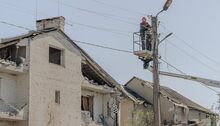
Municipal workers repair the electricity supply in Kharkiv, in May 2024. Photographer: Ivan Samoilov/Gwara Media/Global Images Ukraine/Getty Images
Mission Kharkiv is working with energy companies to equip power plants and substations with blastproof medical kits containing tourniquets and other emergency items, to try to save staff after missile strikes, which Skowronski sees as another way of contributing to the resilience of the system.
Yevhen Zubenko, an engineer at Kharkiv Oblenergo, the regional energy company, stayed in the Kharkiv region to work on the grid in February 2022, heading out on foot into areas close to the fighting. “We had to basically walk, ask the guys at checkpoints what happened and if we could get to the place where the lines were damaged,” Zubenko, 26, said. “Everything was done manually, with a minimum of equipment, a minimum of fuel consumption.”
In April, he and his twin brother Hryhoriy, also an engineer, went to fix a damaged line and were blown up by a landmine. Hryhoriy was severely injured. Zubenko, still in bandages, went back to work a few weeks later. Mines are an enduring hazard in the areas that engineers are working, he said, and drone attacks are frequent. They are often working in open fields without shelters or air raid warning systems. “But we have to work,” he said. “We are needed, we are trained, so we work.”
In the city center, Kharkiv’s resilience has allowed it to start planning for the future. “Despite all the risks, Kharkiv stands,” Polkovnikova said. “The city administration is now restoring our city central park, installing new illuminations — so beautiful, so inspiring. It is clear that we are all very tired, but we have to survive.”
(Corrects circle sizing in the graphic titled “About a Fifth of Ukraine’s Major Energy Infrastructure Lies in Areas Damaged From the War.”)