The New Rockets Racing to Make Space Affordable
Humankind has been flinging scientific equipment, satellites, and even living things (including the occasional astronaut) into orbit for more than 50 years, often for eye-watering sums of money that only governments could afford. But unlike during the early days of NASA preeminence, the rocket launch business over the past few years has matured into one where dozens of private companies around the globe are racing to see how cheaply they can send material into space.
For some outfits, that means developing smaller rockets that are designed to carry just a few hundred kilograms into low-Earth orbit (LEO)—generally altitudes of 2,400 kilometers (1,491 miles) or less—at a cost of as little as $250,000. If you’re a micro-satellite operator who can’t sit around waiting for a larger launch vehicle to sell all its payload slots to other customers, this is a game-changer.
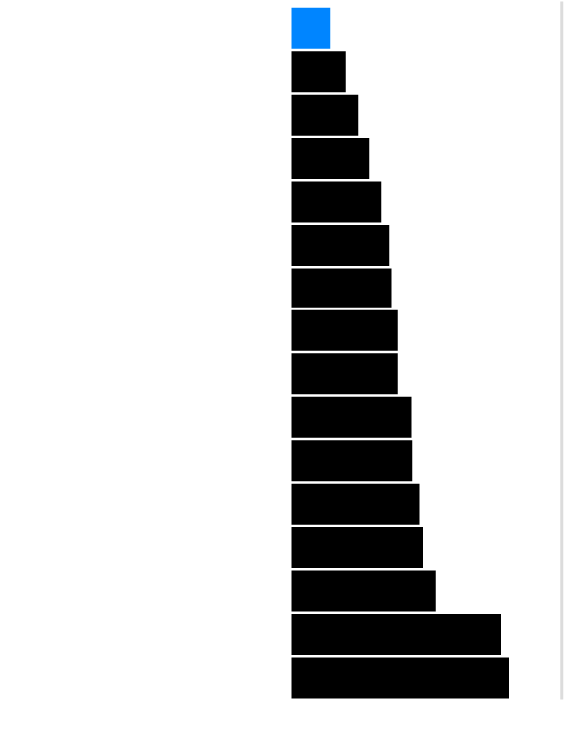
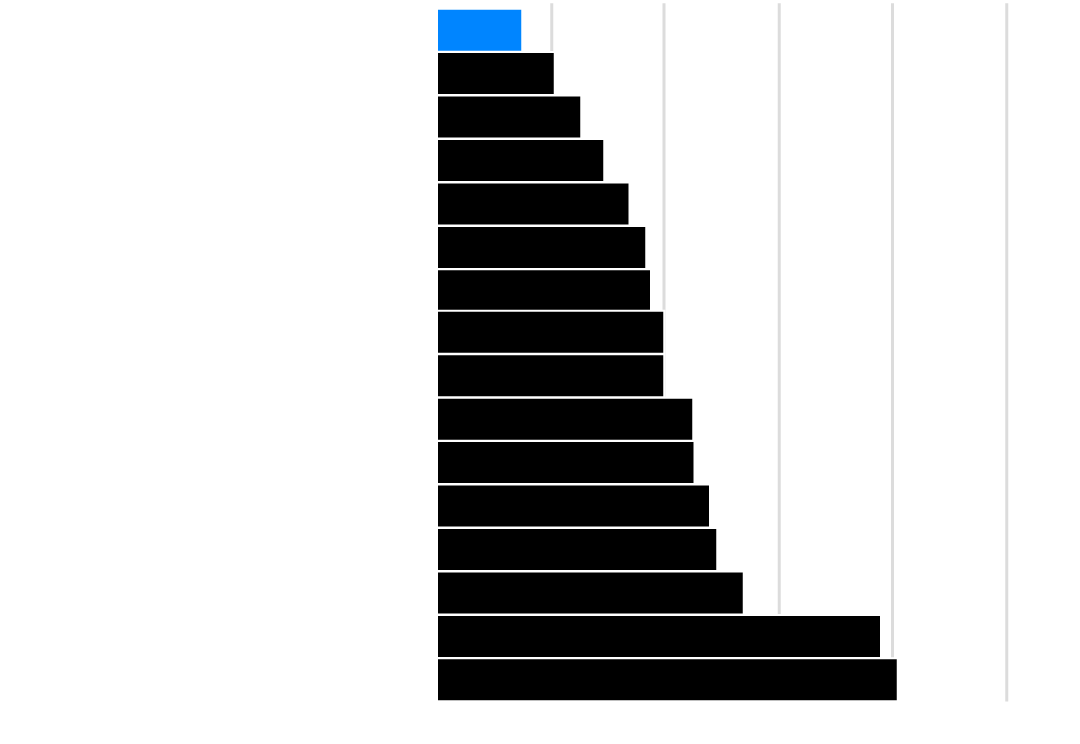
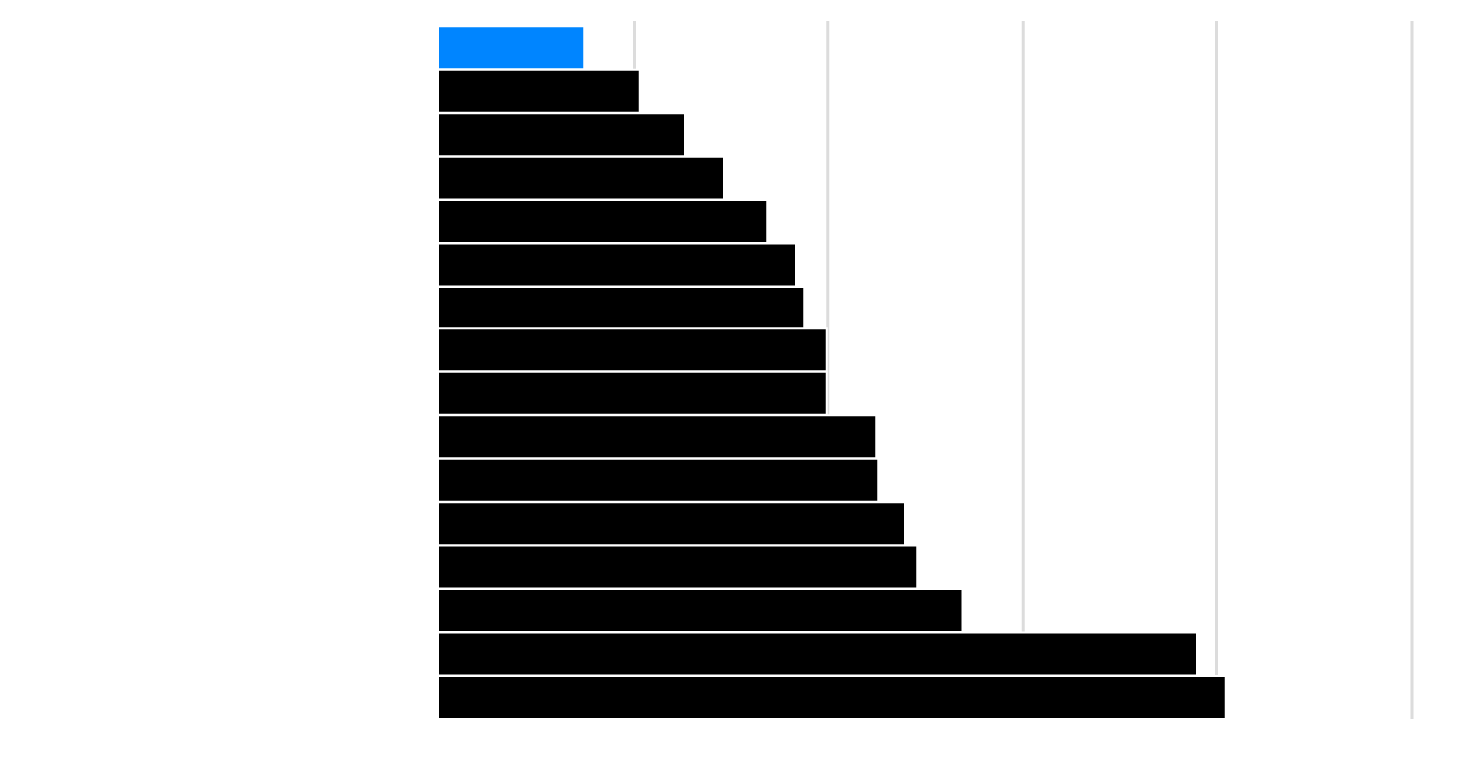
At the other end of the industry’s payload spectrum, companies are working to achieve economies of scale with heavier rockets. Among the 10 most-launched rockets, the most affordable on a per-kilogram basis are SpaceX 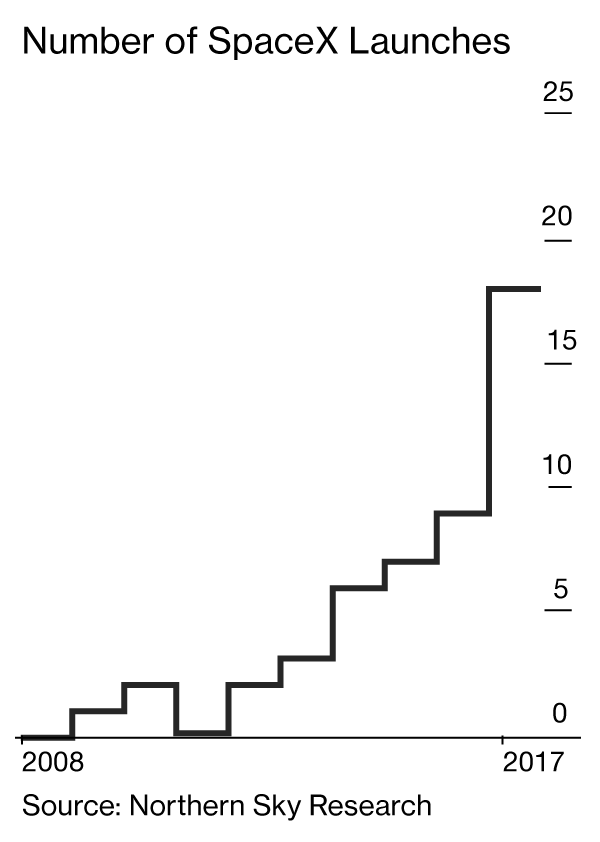 ’s Falcon 9 and Roscosmos
 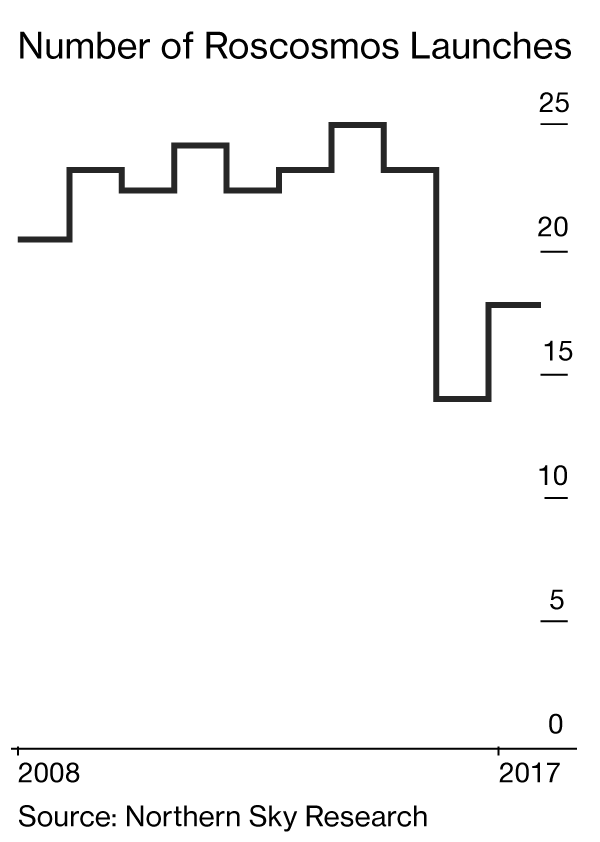 ’ Proton M, both able to lift 20,000 kilograms (44,092 pounds) or more, according to a recent Federal Aviation Administration report. The most cost-efficient overall is the 63,800-kilogram-capacity Falcon Heavy, which successfully test-launched earlier this year. (No cost estimates were provided for several other mega-rockets currently in development, such as NASA’s Space Launch System.)
When Bigger (and Smaller) Is Better
These innovations for very small and very large payload vehicles have led to lower costs for the launch industry as a whole. Carissa Christensen, founder and chief executive officer of consulting firm Bryce Space and Technology, which compiled the FAA report, says there’s been a 10 percent to 15 percent drop in launch costs in real terms since 2010, driven in part by SpaceX.
The company “has dropped launch prices by something around 25 percent,” Christensen says, saving customers as much as $10 million to $20 million, and putting pressure on rivals. Christensen has since seen prices drop at both Europe’s Arianespace 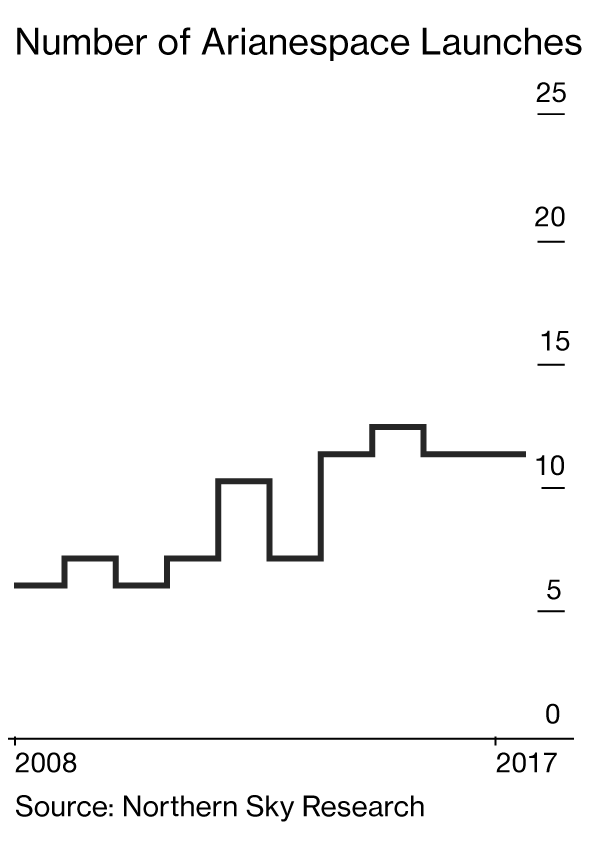 and the Atlas V program of United Launch Alliance (ULA)
 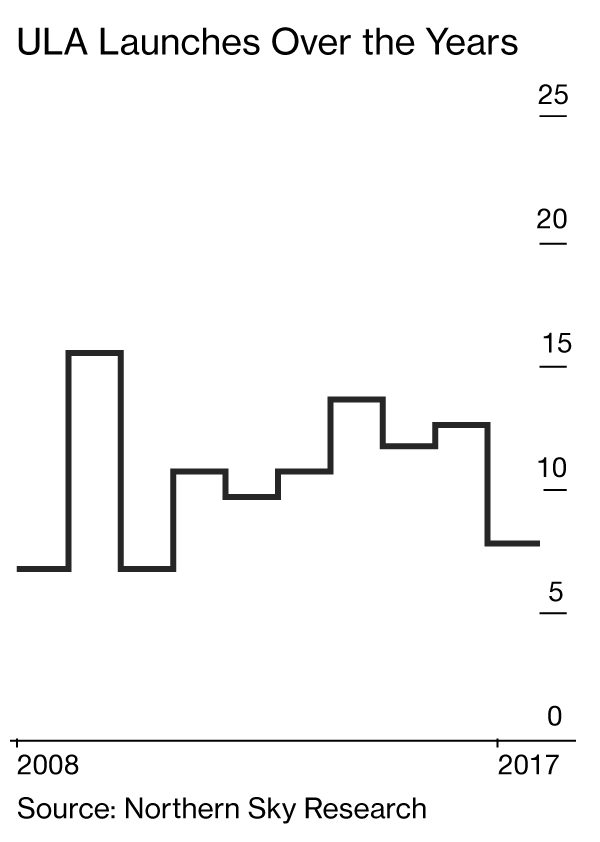 , a joint venture of Lockheed Martin and Boeing that’s been a regular provider of launches for the U.S. government.
Among geostationary or geosynchronous transfer (GTO) missions, which need to achieve a specific orbit of around 36,000 kilometers and are therefore better suited for direct comparisons, average launch costs are down about 20 percent from five years ago, according to Carolyn Belle, a senior analyst at space consultancy Northern Sky Research. Here again, the Falcon 9 leads the pack.
How SpaceX Is Disrupting the Launch Industry
Falcon 9
Proton M
Long March 3B/E
PSLV
Ariane 5
Long March 3C
GSLV
Long March 4B
Long March 4C
H-IIA
Zenit
Long March 2C
Soyuz 2.1a/2.1b
Long March 3A
Delta IV
Atlas V
0
$50k
Falcon 9 (U.S.)
Proton M (Russia)
Long March 3B/E (China)
PSLV (India)
Ariane 5 (EU)
Long March 3C (China)
GSLV (India)
Long March 4B (China)
Long March 4C (China)
H-IIA (Japan)
Zenit (Russia)
Long March 2C (China)
Soyuz 2.1a/2.1b (Russia/E.U.)
Long March 3A (China)
Delta IV (U.S.)
Atlas V (U.S.)
0
10k
20k
30k
40k
$50k
Falcon 9 (U.S.)
Proton M (Russia)
Long March 3B/E (China)
PSLV (India)
Ariane 5 (EU)
Long March 3C (China)
GSLV (India)
Long March 4B (China)
Long March 4C (China)
H-IIA (Japan)
Zenit (Russia)
Long March 2C (China)
Soyuz 2.1a/2.1b (Russia/EU)
Long March 3A (China)
Delta IV (U.S.)
Atlas V (U.S.)
0
10k
20k
30k
40k
$50k
Despite the higher launch costs per payload kilogram of ULA’s Delta IV and Atlas V, both rockets have been a mainstay of U.S. government launch contracts. ULA had a monopoly on U.S. military space launches for more than a decade—until 2016, when SpaceX won an Air Force contract.
While the Atlas V was used to resupply the International Space Station as recently as last year, increased competition has also led NASA to use the Antares rocket from Orbital ATK, SpaceX’s Falcon 9, and Russian-built Soyuz rockets, as well.
That doesn’t mean it’s getting the same cost savings enjoyed by commercial clients, however. According to Northern Sky Research, the U.S. government traditionally pays about twice as much as the commercial average for GTO launches because of the greater sensitivity of what it’s sending up and the additional specifications—and costs—that requires. Sometimes the government pays even more.
Not All Customers Are Equal

Cost per kilo
SpaceX optimal
$6,078
NASA average
$23,750
Launch cost (Falcon 9)
$62 million
$152 million
Payload (Dragon capsule)
10,200 kg
6,400 kg

Launch cost (Falcon 9)
Cost per kilo
SpaceX optimal
$6,078
$62 million
$23,750
$152 million
NASA average
Payload (Dragon capsule)
10,200 kg
6,400 kg

Launch cost (Falcon 9)
Payload (Dragon capsule)
Cost per kilo
SpaceX optimal
10,200 kg
$6,078
$62 million
$152 million
$23,750
NASA average
6,400 kg
Whether it’s a U.S.-based GPS company hiring SpaceX to launch satellites or European scientists piggybacking experiments on an Arianespace rocket, the true cost is ultimately negotiated based on the payload, launch site (closer to the equator is better), launch angle, and other factors. Still, these very technical big-dollar issues are increasingly being impacted by the changing economics and new generation of commercial space titans that are quickly transforming the launch industry.