Businessweek | The Big Take
The $11 Billion Casino-Style Economy Built on Players Who Can Never Cash Out

“please remove this game from my computer ..thank you,” read the email to a customer service representative for High 5 Casino, a mobile game that lets people spend virtual coins on Las Vegas-style slot machines.
“Sorry to hear you’re having a problem. I’m not sure I understand exactly what your issue is,” responded an employee at High 5 Games, the app’s maker. “Could you give us a little more detail on exactly what is happening?”
“thank you for your quick reply,” the customer wrote. “the games are fun to play, but I am having a problem and I need to stop playing so much as it’s a bit of an addiction and buying credits are totally out of control for me …as I guess I am a bit embarrassed to say ! So my only way is to have it removed as I am having some financial difficulties as to my playing (as I live alone and its boredom that keeps me involved) thank you for your understanding !! just my weakness !!”
What transpired next might break the law at a regulated casino or sportsbook. If a customer, in person or online, declares they’re addicted to gambling, living alone, in financial trouble and out of control, many US states mandate essentially the same response: Offer support, including self-exclusion. Place them on a list of banned customers.
But this is a different kind of gambling. In fact, the game makers say, it isn’t gambling at all, because it’s done through what the industry calls social casinos. Tens of millions of people play them daily. High 5 Casino, Jackpot Party, Slotomania and similar apps are billed as just-for-fun diversions that can be played for free.
Big Take
The Online Games Where the House Always Wins
Follow The Big Take daily podcast wherever you listen.
And they can be: You download the game at no cost and start with a small stash of coins. But you’ll almost certainly run out—because, as at every casino, the house always wins. Then you’ll be prompted through a stream of pop-ups to pay real money for more coins, to avoid waiting (maybe an hour, maybe all day) for the game to dispense more free ones. Even when you pay, and win, you can’t cash out. It’s the defining element of a social casino; the prize is the make-believe coins, and perhaps some dopamine.

Considering you can’t win real money, casino-style games generate an astonishing amount of actual revenue, more than $11 billion in 2025, according to the market intelligence firm Sensor Tower Inc. And actual pain: Some players have spent more than $1 million, contemplated suicide, mortgaged houses or divorced their spouses over the games.
High 5 representatives at first appeared to understand the gravity of the customer’s situation. “We appreciate you writing in,” another employee responded. She offered to close the account.
Then she didn’t, really. “We would hate to lose you as a player, we have closed out your coin store preventing you from making any future purchases,” the High 5 worker wrote. “Furthermore, for being such a loyal player, we have credited your account with one billion coins for your committed loyalty.” A billion coins was enough to extend play for days. Did the company consider this might also be enough to motivate a self-described addict to set up a new payment profile and eventually start buying coins again? Asked that in court last year, Anthony Singer, High 5’s chief executive officer, said no.
This was just one of many matters Singer had to explain to a jury in Tacoma, Washington, as part of a class action accusing the company of violating state gambling laws. He became the first social casino executive questioned in open court about the hidden mechanics of this business.
Big spenders, a jury was told, were described within High 5 as “whales” or “monetizers.” When a staffer reported that one user—“good ol’ Patty… the whale with crazy monetization habits”—had bought several coin packages in a single day, another suggested sending “a box of wine or three” to her home to keep her tapping away at her favorite game, Ciao, Roma! “Thumbs up,” responded Patrick Benson, High 5’s vice president for integrated marketing. “I hope she sits down with a box of wine tonight and plays C. Roma all night.” High 5 declined to comment for this story.
Elements of social casinos pervade all sorts of games that are nominally not about gambling. Almost every profitable online game has adopted the gambling mechanics of slots and dice rolls, embedding them into what look like fantasy adventures, shooter quests or kids games. Even venerable Hasbro Inc. turned the century-old Monopoly board game into the hit app Monopoly GO! The app’s revenue has topped $6 billion since it was launched in 2023, thanks to in-game sales of dice rolls, mystery sticker packs and other elements.
The tech platforms—Apple, Google, Meta—have a role in this as well. They’ve collected a cut of as much as 30% for themselves on in-app purchases. They vet the apps before allowing them in their stores and deliver the software and its updates to users. Google and Apple also host real-money, licensed gambling apps in their stores where legally allowed, but they don’t collect commissions from them because the platforms prohibit the use of in-app billing for such wagers.
No platform appears to have benefited more from the in-app economy than Apple Inc., whose App Store sees more purchases than any other mobile marketplace. The company points out that the vast majority of app developers pay zero commissions (purchases such as food delivery go directly to vendors) and most who do pay commissions are eligible for a reduced 15% rate through small-business and other programs. But thanks to a relatively smaller circle of higher-grossing apps, Apple makes more money from games of all kinds than it does selling laptops, a Bloomberg analysis shows. Apple said it disputed this assertion because it was based on estimates and on metrics that Apple itself doesn’t assess.
A few states have outlawed social casino games. Others have sought to limit their reach. The platforms have labeled the apps with age ratings intended to warn off minors. But revenue continues to grow. It’s more than doubled in the past six years.
Mark Zuckerberg was still the wispy Harvard University dropout in a gray T-shirt, Time magazine’s freshly named Person of the Year, when Facebook blew past 500 million global users in 2010 and briefly surpassed Google as the most visited site on the internet. Life began its inexorable shift online. You started hearing from friends you hadn’t seen in years and found yourself spending time on Candy Crush and FarmVille. Those games, like many others, dangled in-app purchases of power-ups or magic gems or what-have-you, but the money involved was modest. (At least at first; there are reports of people spending $100,000 on Candy Crush.)
Steve Jobs, meanwhile, had already unveiled the App Store as the sole repository of third-party software for the iPhone, with Apple taking its 30% commission on the sale of apps and, later, in-app purchases. Asked during a 2008 presentation whether that constituted a monopoly, Jobs, in his black mock turtleneck, shrugged. “We don’t intend to make money off the App Store,” he said. “We’re basically giving all the money to the developers here, and if that 30% pays for running the store, that would be great.”
“I felt like a rat that needed to come back and keep playing”
The real potential soon became clear. In 2010 a handful of Seattle developers introduced what they called a “social network based casino game,” a slots game named DoubleDown Casino. By the next year, 4.7 million people a month were playing, making it the fourth-most-popular game on Facebook (which processed the payments and also took 30% of the sales). In 2011 the Israeli company Playtika brought out Slotomania, another hit. In-app payments cascaded in.
The explosive growth surprised Sean Ryan, who joined Facebook in 2011 as its first director of games partnerships and began meeting with the makers of the site’s biggest apps. “They were all games,” he says. When he met with Playtika, he grew more mystified. “I was like, ‘Well, that doesn’t make sense, why would people play this if they don’t stand to make money?’”
That same year, he says, someone in the legal department at Facebook, now renamed Meta Platforms Inc., encouraged him to call and do a kind of welfare check on a gamer who’d spent $10,000 in a month. “This was early in the days of free-to-play games, and we didn’t even know it was possible to spend that much,” Ryan says. The customer, as Ryan tells it, cursed him out. “Some people spend money on drugs, some people spend money on cars,” he recalls the man saying. “I spend money on games. Don’t ever call me again.” Facebook’s lawyers reviewed the social casinos and determined that it was entertainment, not gambling, Ryan says.
The social casino business, no less than the regular casino business, was built on a small slice of players who spend big and have a hard time stopping. Catherine Witt started playing DoubleDown Casino in 2011 after her youngest son died by suicide. Her 25-year marriage was collapsing. “I stayed in my bedroom a lot and played,” she testified in a deposition for a 2018 class action that accused the game’s maker, Double Down Interactive, of violating gambling and consumer protection laws in Washington state. She said she lost almost $50,000, ran up credit card debt and fell behind on taxes.
Another woman, now 78, told the court in the same case that she’d contemplated taking her own life because of the stress that putting thousands of dollars into DoubleDown caused her husband. “However, I’m a strong Christian and I would not commit suicide,” she testified. (The statement was later redacted in court records, so Bloomberg Businessweek isn’t naming her.)
Sandra Logan, a veteran, now 65, was laid up with a broken back when, she told the court, she got hooked on DoubleDown Casino, playing nonstop for two or three days, quitting, then starting again. “I felt like a rat that needed to come back and keep playing,” she said in a deposition. She finally had to admit to her daughter that she’d run out of money to buy food. A woman who prided herself on buying $5 shirts at The Salvation Army, Logan was profoundly embarrassed by the experience. “That’s where I lost my ability to be a thrifty woman,” she said. “I just lost it that summer.”
Mystifying as this behavior is, even to the players of social casino games themselves, it fits a pattern. The cultural anthropologist Natasha Dow Schüll spent more than a decade on Las Vegas casino floors before publishing her landmark 2012 study, Addiction by Design. The secret clicked for her when a slot machine addict named Mollie described “the zone”: Awareness of time, and even of her own body, slipped away. The point is to stay in this zone for as long as possible, not necessarily to win. “As machine gamblers tell it, neither control, nor chance, nor the tension between the two drives their play; their aim is not to win but simply to continue,” Schüll wrote.
The year after Logan hit bottom, a game designer at Double Down told a supervisor that his team had assembled a library of key works, among them Schüll’s book (misremembering the title as Design by Addiction), and asked for reimbursement for similar titles on player psychology.
“I’m happy to approve this,” replied Joe Sigrist, then general manager.
That exchange turned up in emails handed over in discovery to the Chicago law firm Edelson, which was behind the Double Down suit, the High 5 suit and a number of others. Schüll, by then a professor at New York University, got an email in 2018 from an Edelson lawyer, asking if she agreed with the companies that virtual chips weren’t things of value. “I said, ‘This is an absurd thing for them to argue,’” she recalls.
It wasn’t merely semantics. This supposed lack of monetary value was precisely what allowed social casinos to remain unregulated, and thus to have no explicit legal responsibility for the predicaments of their customers.
Schüll told the lawyer that, even in real Las Vegas slots, people no longer use coins—they get virtual credits on a screen. The allure goes back to the famed “Skinner boxes” developed in the 1930s by the behavioral scientist B.F. Skinner, who found that dispensing pellets to rats at random intervals led some to frantically press a lever in search of them. Some of the addicts Schüll followed even had a sardonic name for themselves: the rat people.
Jay Edelson, founder of the firm, had earned a reputation as what one profile called “tech’s least-friended man”—a baby-faced boogeyman who’d won more than $1 billion in settlements from data privacy cases. The idea of going after the social casinos had emerged from a strategy session in 2015, and he recalls being ambivalent; it was tough to muster righteous energy over people who’d lost a few bucks wasting time on the internet. Nonetheless, the firm filed its suits.
The courts initially reinforced Edelson’s doubt. “We started bringing the cases shortly after the meeting and got destroyed,” he says. Most judges ruled that real money had to be at stake for the games to count as gambling. One ruling declared the case was exactly what a class action shouldn’t be.
The firm’s argument about the nature of social casino games finally broke through in a suit in Washington state against Big Fish Casino, owned at that time by Churchill Downs Inc. The 9th US Circuit Court of Appeals ruled in 2018 that virtual coins were a “thing of value,” because they extended the ability to keep playing a game. With that green light, Edelson brought similar actions against every top social casino operator under the state’s gambling and consumer protection laws.
The game makers argued in court filings that their games weren’t illegal gambling, because players don’t need to pay to play and are never winners or losers of something of value. Then they settled. In four years, settlements in the Washington cases totaled well over half a billion dollars. Playtika paid $38 million in 2021. Big Fish Casino paid $155 million that same year. Zynga Inc. paid $12 million in 2022, and SciPlay Corp. paid $24.5 million. DoubleDown, whose case involved a larger class than the other companies, paid $415 million in 2023.
Users in some of these cases received refunds. Playtika, Zynga and DoubleDown declined to comment for this story. SciPlay declined to comment on litigation and settlements; the company said it “operates within applicable laws.” None of the companies admitted wrongdoing, and many continued operating.
DoubleDown is still a prodigious cash generator, with a $103 million profit on sales of $360 million last year. In its latest annual earnings report, the company essentially recognized the rat people: About 8% of its social casino users spent actual money, it reported, and they paid an average of more than $2,800 each last year.
High 5 didn’t settle, and hence discovery in that case was extensive. Portions were read aloud in court to Singer, the chief executive on the stand that day in Tacoma.
“Right away, she started with an addictive spending pattern,” a High 5 staffer wrote to a colleague about a gamer—meaning to suggest a positive data point, not something to be monitored. “She made 11 purchases on her first day.” In another exchange, employees hashed out strategies to reactivate three whales who hadn’t spent anything in months. They listed, in order, the sums each person had sunk into the game: $1,044,291; $630,995; $755,734.
Some players were singled out for what High 5 staffers called “coin drainage.” They got access to exclusive games, a seeming reward. These games were designed with high minimum bets so the players would burn through their stashes quickly and, ideally, spend more. “The objective of this promotion is to drain coins from whales with large bank rolls,” a High 5 employee wrote in an internal email.
“I became a game dev to make games, not to design manipulative monetization systems with some gameplay sprinkled on top”
The odds never changed, but players found that the deeper they got into games, the more expensive the coins became to purchase. A package of coins that once cost $2 might suddenly cost $10.
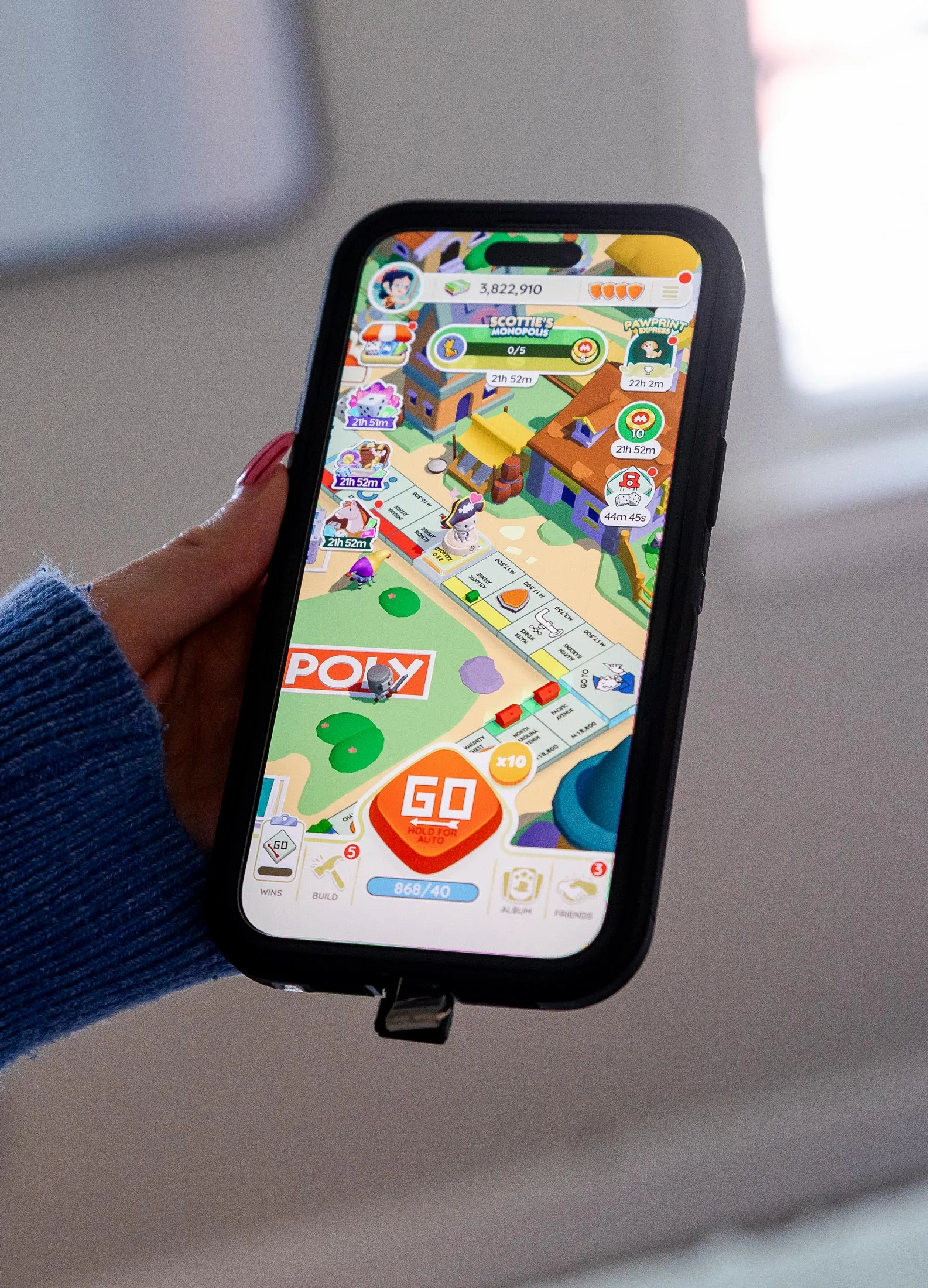
Scopely Inc., the game maker that brought Hasbro’s Monopoly GO! to market three years ago, doesn’t characterize it as a social casino game. But behind its board game veneer, Monopoly GO! borrows the mechanics of a popular slot machine game called Coin Master. Land on a railroad or “Chance,” and you’re sent to side games that are basically roulette wheels and scratch-off cards. Random rewards abound; it’s a Skinner box, more or less. Sensor Tower puts it in its “casino” game category.
Lilyana Iriti, a freight and logistics company account coordinator in Carmel, Indiana, started playing Monopoly GO! with friends soon after it launched and then started a chat group that’s had as many as 15 members. They call themselves the Monopoly GO! Mommies. “Nothing beats the feeling of being able to endlessly roll dice and win fake money with my friends,” she said in an email. On the other hand, having spent at least $2,000, she realized recently that she needed to set boundaries and “reeled myself in to a $40-a-month budget.”
This is a community that both loves and hates the game. Brenna Ingram of Grand Rapids, Michigan, another founding member of the group, says she’d advise people thinking about playing the app not to start.
Monopoly GO! has been a balm for Hasbro. It brought in $168 million in revenue in fiscal 2025, almost 4% of the company’s total. That helped counter falling toy sales and was also an important talking point with analysts concerned about Hasbro’s relevance in the digital age. When one analyst last year asked the chief financial and chief operating officer, Gina Goetter, how he should value the company’s stock now that kids aren’t playing as many board games, she joked, “Got to get them hooked on Monopoly GO!”
Hasbro said in a statement that the game is “a strong example of how we’re bringing one of our most iconic brands to a new generation of players” and that it works with Scopely, the developer and operator, to ensure it “delivers a fun, engaging and responsible player experience.” Scopely said it’s proud that hundreds of millions of people play its games and that Monopoly GO! players have spent less than $1 per month on average, with most making zero purchases. “Our games are designed to be equally fun to play for free as they are for players who choose to make in-app purchases,” a company spokesperson said via email.

Still, the widespread use of gambling-like rewards has begun to draw scrutiny from regulators, and is a sore point even among game designers. “Who wants to work in perfecting an algorithm to maximize how much the game will be able to foster a gambling addiction?” Nadina Carla Cardillo, a graphics developer in Cádiz, Spain, wrote in an email. “We are, as developers, essentially being asked to enshittify our games to maximize corporate profit through predatory practices.”
She was reacting in part to a post on LinkedIn that caused a stir last year. Ilkka Paananen, the CEO of Supercell, a Finnish company that makes the popular Clash Royale game, wrote that proposed European Union restrictions on in-app purchasing would “kill” the continent’s game industry. Responses poured in from developers—many of whom supported the restrictions. (In Clash Royale, players buy jewels to unlock chests containing random rewards that help them progress in the game.) “I became a game dev to make games, not to design manipulative monetization systems with some gameplay sprinkled on top just to keep the lights on,” wrote János Barkóczi, founder and CEO of TryAgain Game Studio in Hungary.
Supercell said in a statement that it puts safety over monetization and builds its games to actively discourage unhealthy play—by, for example, reducing the rewards available the longer a session lasts. “Regulations need to be designed thoughtfully and with care: in a way that acknowledges the great economic and creative impact that the games industry has in Europe,” Supercell said. The EU proposal is still under discussion.
Ryan, the former head of game partnerships at Facebook, says those designers with misgivings are clinging to the lost era of $40 game cartridges. Industry growth now rests on in-game purchases—which, he says, do require some willpower to resist. “Are designers being asked to encourage people to continue? Of course they are,” says Ryan, who now runs his own online gaming company, Zoot.
He samples new games for at least an hour each day. But he tries not to play any single game for more than 10 hours. “I find in some of these games, when I’m about five hours in, the pinch begins,” Ryan says. “The pinch is when you start to run out of a resource, a life, a this—that’s the beginning of the monetization loop. What do you do? What I do … I play the game a little longer, and then I shut it down and I go on to a new one.”
Steve Jobs got a lot of things right, but he doesn’t seem to have anticipated the value of the App Store. By fiscal 2025, running a storefront for games with billions of dollars of payments had become a business rivaling computers, according to a Bloomberg analysis of Apple’s financial filings, analyst estimates and data from Sensor Tower.
Apple reported that personal computers (counting both desktops and laptops) had $33.7 billion in sales last year. The company doesn’t report an equivalent figure for the App Store, but analysts estimate that its sales were also around $33 billion. Close to half of App Store sales have come from games in recent years. The direct production costs of services are far lower than for hardware. As a result, based on the estimates, Apple generated gross profit of more than $11 billion from game spending, compared with $9 billion for Macs.
Apple, which doesn’t report the profitability of product lines, said Bloomberg’s analysis “is fundamentally flawed, relying on compounded, inaccurate third-party estimates to manufacture speculative financial conclusions.” When asked, the company didn’t deny it made more gross profit on games than on Macs last year, saying it doesn’t calculate such numbers.
Around the time Edelson began settling with the game makers, the firm also initiated class actions in California against the tech platforms, calling Apple, Google and Meta co-conspirators in an illegal gambling enterprise that exploits consumers and reaps billions in profits. The tech companies sought relief under Section 230 of the Communications Decency Act, which broadly shields online publishers from liability for content on their websites. Last September, a judge in the Northern District of California rejected the conspiracy claims. But he allowed the case to proceed on the basis of the platforms' role as payment processors, not merely publishers, of the social casino apps.
A trial is not yet scheduled.
Meta and Google said social casinos must comply with those platforms’ standards and applicable laws, including measures protecting minors, and cannot offer anything of monetary value. “We maintain clear distinctions between licensed real-money gambling and social casino games,” Google spokesman Dan Jackson said in a statement.
Apple said in a statement that social casino games are a small fraction of the overall game market and that Bloomberg’s reporting conflates the two. The App Store is designed to be a safe and trusted place for everything from “family board games to action adventures,” the company said. “For apps that do feature simulated gambling, we lead the industry in user protections by enforcing a strict 18+ age rating and requiring developers to transparently disclose the odds for randomized virtual items before purchase.”
As the case against the platforms proceeds in the federal courts, Edelson’s original arguments may have found support from an unlikely source: Apple. In 2020, Epic Games Inc., the maker of Fortnite, sued Apple over the App Store commissions. (Fortnite players buy a currency called V-Bucks, which they use to buy in-game items such as outfits, or “skins,” to change a character’s appearance.) By Epic’s argument, Apple was doing very little to justify keeping 30% of the spending on virtual goods in the game. The case went to trial in Oakland, California, in 2021.
When Apple CEO Tim Cook took the stand, he testified that the majority of App Store revenue came from in-app purchases by gamers. Documents produced in court showed that 1% of gamers essentially shouldered that cost, accounting for 64% of game billings in the App Store. (The amounts have fluctuated. In 2016, the documents revealed, total spending from gamers brought in as much as 81% of App Store revenue. More recently, artificial intelligence apps, typically free to download but with paid in-app upgrades, have become a significant contributor.)
US District Judge Yvonne Gonzalez Rogers pressed Cook. “The gaming industry seems to be generating a disproportionate amount of money,” and subsidizing free apps, such as banking, she told the CEO as he sat in the witness chair.
“We've made a choice, yeah,” Cook said. “There are—there are clearly other ways to monetize and we chose this one because we think this one overall is the best way.”
“But it seems to be lucrative and—and focused on—on purchases that are being made frankly on an impulse basis. That's a totally different question about whether that's a good thing or not,” the judge responded. “But it does appear to be disproportionate.”
Four months later, Rogers ruled that Apple, while not operating an illegal monopoly, had unfairly banned alternative payment methods from the App Store. How the ruling will be implemented is still being hashed out. In a footnote to her written opinion, the judge returned to the point she’d made to Apple’s chief, citing the narrow concentration of income from “exorbitantly high spending gamers.” “These consumers frankly appear to be engaging in impulse purchasing and both parties’ profits from this sector are significant,” she wrote. Such conduct, Rogers added, “is an area worthy of attention.”
A pillar of Apple’s defense had been that it played an active and important role in generating those in-app sales. Mike Schmid, then head of games business development for the App Store, said in a written declaration submitted to the court that, in addition to spending money on advertising for Epic, Apple had helped with gameplay design, marketing and monetization. “Apple’s App Store team provided all-hands-on-deck treatment to address Epic’s non-stop asks,” Schmid wrote, “which frequently involved middle-of-the-night calls and texts.” (Apple says that while it helps developers adopt new technologies to find customers and sell to them, that doesn’t mean it dictates the mechanics of individual games.)
It may have been the defense the company needed at the time. But it meant Apple was tying itself directly to the game makers and their methods. That’s consistent with what developers of social casino games say. Iowa-based SciPlay said in a statement that the platforms “play an important role” in distribution and access to audiences and “provide infrastructure, tools and support that help ensure games can be delivered reliably and consistently to players.” Eduardo Falani, director of VIP and customer service at SciPlay, which makes games including Jackpot Party and Quick Hit Slots, says: “Apple and Google both have executives and teams whose sole focus is making sure game developers have what they need to thrive, because ultimately that’s what keeps their 30% revenue share flowing.”

While so many of its peers settled court cases, High 5 chose to keep fighting. Singer remains the most prominent executive to answer in public. He did so against a challenging background. The previous June, US District Judge Tiffany Cartwright had ruled High 5’s games illegal under Washington state law. According to the state’s Recovery of Money Lost at Gambling Act, the plaintiffs were entitled to recover the value of what they’d lost. Now it was up to the jury to decide how much High 5 should pay them.
Singer’s appearance on the second day of the damages trial became a turning point. At first nonchalant—“I go by Tony, if you want,” he offered—the longtime New Yorker talked so fast that one lawyer asked him to slow down to help out the court reporter. The exchanges soon became more combative, with Singer rejecting the very premise of the judge’s 2024 decision. “People in the industry, no one thinks this is gambling,” he said.
Finally, as the plaintiffs’ lawyers read out email after email showing how his employees tracked and targeted big spenders, Singer told the court he was disappointed to hear how they’d talked in private about their best customers. He said he didn’t like terms such as “whales,” “monetizers” or even “users.” “I prefer purchasers and players,” he said.
Lawyers pressed him on whether he had any concern for the welfare of customers as he earned a salary of $1.3 million a year and the company, in which he was the largest shareholder, sold $440 million in virtual coins in just under a decade. One lawyer, Kaleigh Boyd, asked Singer: “You didn’t reach out to these individuals who were spending tens of thousands of dollars on your application to see whether or not they were struggling?”
“They wrote me a lot of letters,” he responded. “The players reached out to me and said, ‘Thank you for what you have made.’ They told me story after story of what they did. The letters coming from people’s deathbed telling me, ‘Thank you, High 5. Thank you, High 5.’ People with cancer saying, ‘You got me through this. Thank you.’”
He went on: “This product, what you guys think is bad, is actually so loved by people. It got them through Covid. It got [them] through suicide attempts. This thing is a good thing. I understand there is a little bit of bad, but, oh, my God, they are so good. If I could show you those letters, you would understand,” Singer said.
“Mr. Singer,” the plaintiffs’ lawyer finally interrupted.
“Sorry.”
“I am going to ask you to listen very carefully.”
“Yeah, repeat the question,” the CEO said.
“The question I am asking is: For the individuals that you had identified as spending tens of thousands of dollars on your application, you did not reach out to those individuals to see whether they were struggling in any way with your application, correct?”
“I personally didn’t,” Singer said.
Boyd presented him with more emails, about players deemed “dead” (because they weren’t spending money) and about big spenders the company sought to win back. In one of them an employee asked, “Have we tried to reactivate this whale in an individual way?”
“Do you see that?” the lawyer asked the CEO.
“Yes,” he responded.
“She’s referring to getting this whale to start spending money in your online casino again, correct?”
“Yes.”
“It is not just about entertainment for this person, is it, Mr. Singer?”
“No.”
“No, it is about getting them to spend money, right?”
“Yes.”
“Because when they spent money, you make money?”
“Yes, but—yes.”
The jury returned a verdict days later, ordering High 5 to pay almost $25 million in damages. In April, the company agreed with the plaintiffs on a settlement, the terms of which haven’t been disclosed. High 5 no longer offers the game in Washington state. In most others it’s still free to play, via Apple, Facebook and Google. —With Priyanjana Bengani, Aaron Gordon and David Ingold