Most Coronavirus Vaccine Projects Are Taking Unorthodox Routes
The more than 200 Covid-fighting efforts under way are generally skipping the chicken eggs and often trying to reinvent how vaccines work.
Coronavirus particles, or virions, attach to the surface of a cell with their spikes, then pierce the cell and release a strand of RNA. The genetic code it carries hijacks the cell’s machinery to make more virions, which seek new targets.
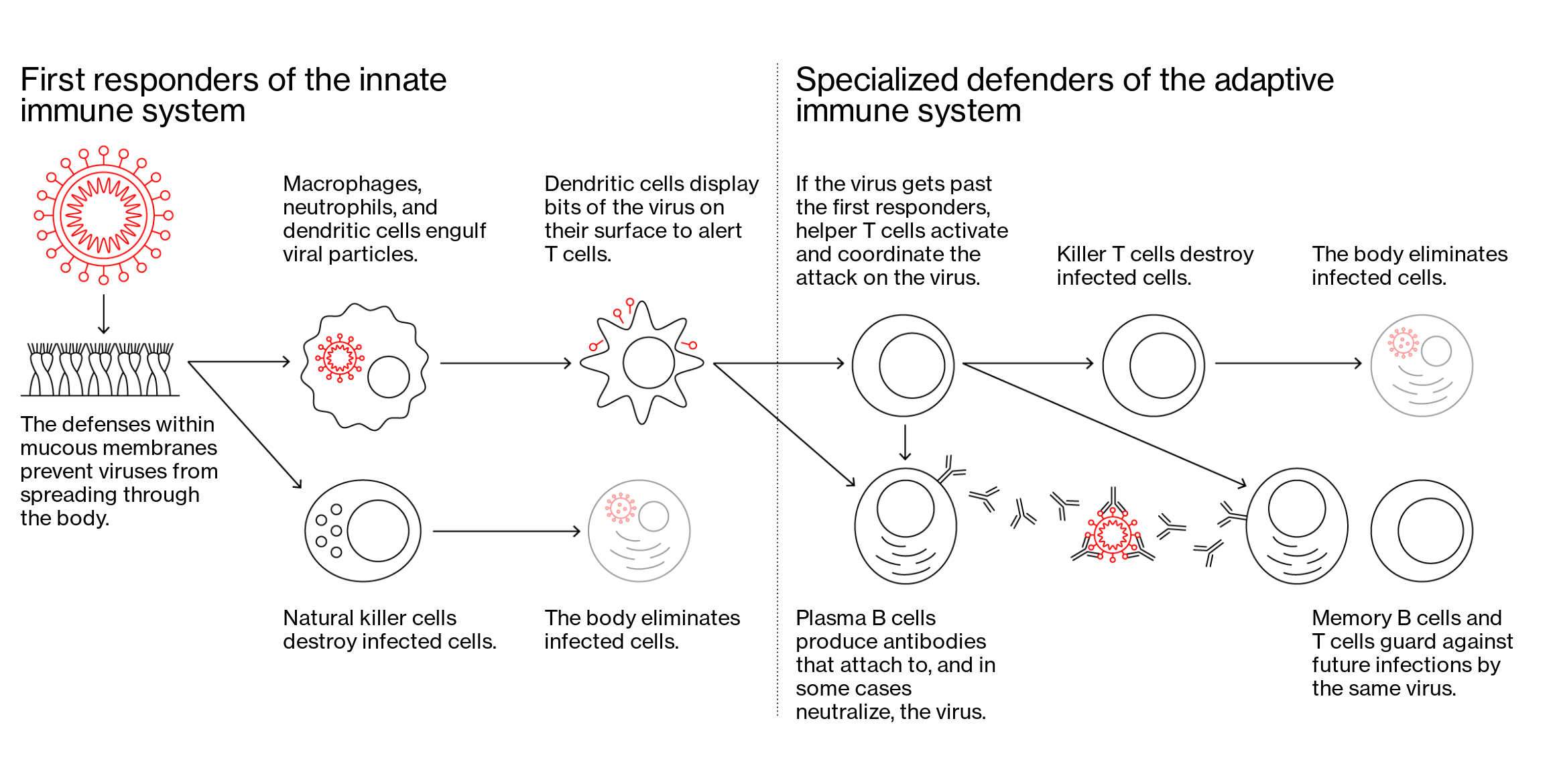
Here are some of the approaches being tried by researchers working on coronavirus vaccines. Some of the more than 200 competitors are using techniques that have been honed over more than a century, but most are experimenting with far less proven tactics.
Whole Pathogen
The killed or weakened virus is injected whole into the body, as in a typical vaccine.
The Players
The Bandim Health Project, based in the West African nation of Guinea-Bissau, is testing whether a polio vaccine can work against SARS-CoV-2, the coronavirus that causes Covid-19, possibly by fortifying the innate immune system. Others are testing tuberculosis and measles shots.
Codagenix Inc., of Farmingdale, N.Y., together with Serum Institute of India Pvt. Ltd., is testing the safety of a live, carefully “deoptimized” version of the virus.
Beijing’s Sinovac Biotech Ltd. says its vaccine, based on inactivated virus particles, spurred the creation of neutralizing antibodies in more than 90% of people tested.
Subunit
The vaccine is made from a harmless fragment of SARS-CoV-2, usually a surface protein.
The Players
Sichuan Clover Biopharmaceuticals Inc., of Chengdu, China, in collaboration with GlaxoSmithKline Plc, grows proteins resembling the virus’s spike protein in a mammalian cell culture and injects them into muscles to trigger an immune response.
Novavax Inc., of Gaithersburg, Md., grows synthetic spike proteins in armyworm moth cells. Supported by U.S. federal funding, it plans to make more of the proteins in the Czech Republic and other places.
Others to Watch
Medicago Inc., a Canadian company one-third owned by tobacco giant Philip Morris International Inc., grows virus proteins in an Australian relative of the tobacco plant.
Sanofi Pasteur Inc. mass-produces bits of the virus using the method it developed for its influenza vaccine, Flublok.
The University of Pittsburgh Medical Center delivers viral particles using a Band-Aid-like patch with 400 tiny needles that dissolve into the skin.
Nucleic Acid
Genes from the virus are inserted into the body’s cells, causing them to manufacture viral fragments.
The Players
The University of Oxford, teaming with AstraZeneca Plc, uses a weakened chimpanzee adenovirus as a vector to carry the genetic code for the spike protein into cells. It says its shot stimulates T cells and antibodies.
CanSino Biologics Inc., working with the People’s Liberation Army, splices the virus’s spike protein into a safe, nonreplicating version of a human adenovirus, which ordinarily causes colds and pinkeye. It’s approved for military use in China.
German companies BioNTech (with Pfizer) and CureVac (with GlaxoSmithKline) package coronavirus-fighting messenger RNA in tiny particles that look to the body like cholesterol. So does Moderna Inc. of Cambridge, Mass., which is working with the U.S. National Institute of Allergy and Infectious Diseases.
Others to Watch
Merck & Co. is splicing the spike protein into viruses for measles and vesicular stomatitis, which infects horses and cattle.
Inovio Pharmaceuticals Inc., of Plymouth Meeting, Pa., injects rings of DNA into the skin or muscle, then uses electrical pulses to briefly open tiny pores in the cells for the DNA to get in.
Work in Progress
Status of human trials for the roughly 200 vaccine candidates, by approach
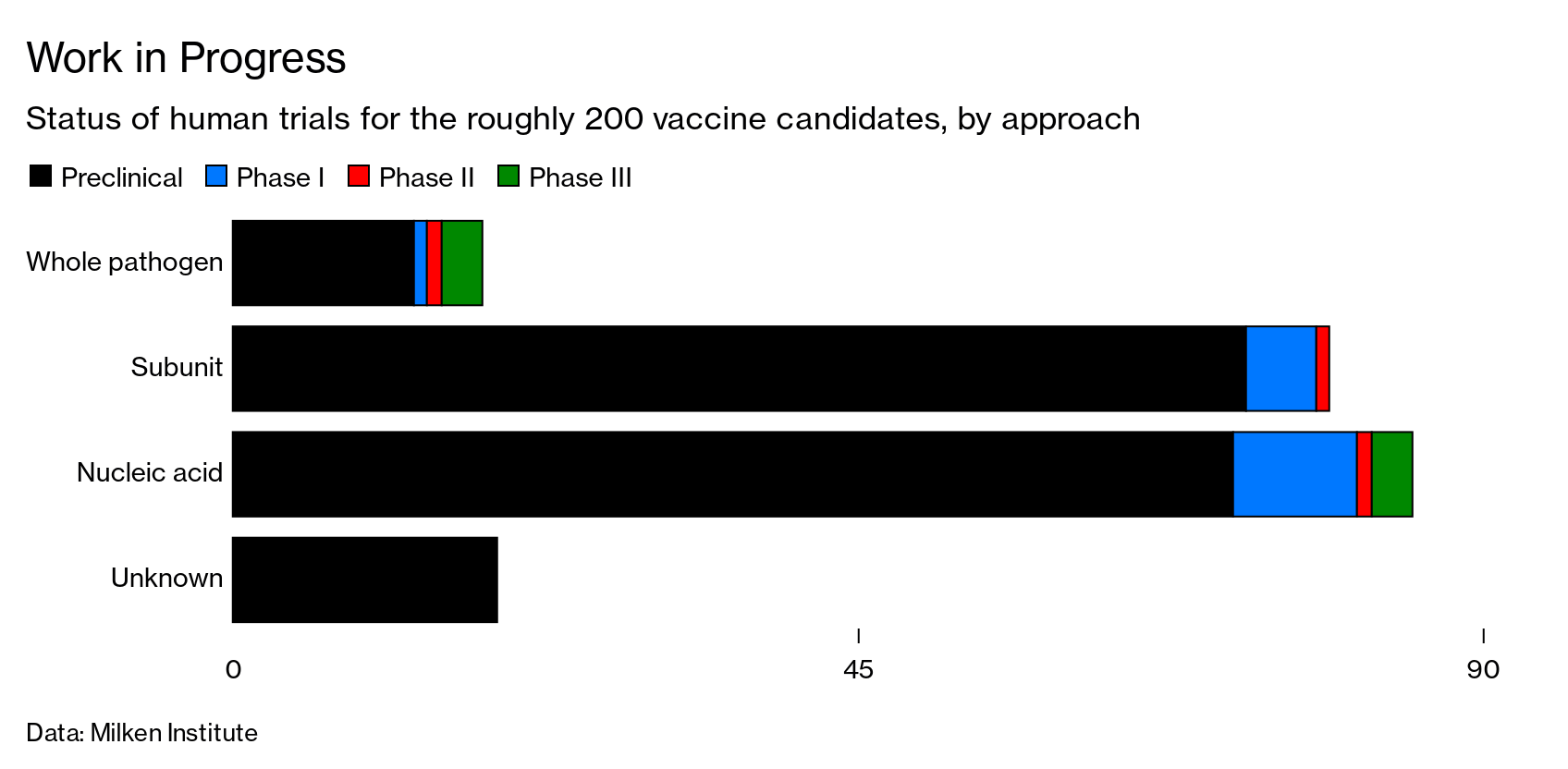
Data: Milken Institute
(Corrects the part of Y-shaped antibodies that attaches to virus in diagram.)